Thursday, October 8, 2009

Climate Progress

Climate Progress


Energy and Global Warming News for October 8: Over 90% of Americans support solar power development

Posted: 08 Oct 2009 09:17 AM PDT

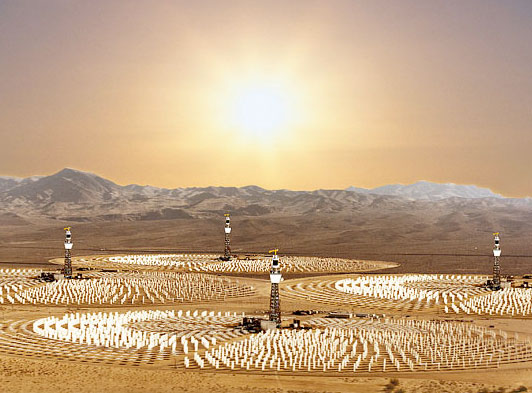
http://greenernews.files.wordpress.com/2009/07/solar_power_molten_salt.jpg

92% of Americans support solar power development, study says

The vast majority — 92% — of Americans think it's important for the country to develop and use solar power, according to a study released today, making the alternative energy option potentially one of the most popular things since puppies or ice cream.

The sentiment was echoed almost evenly across political parties, with 89% of Republicans, 94% of Democrats and 93% of Independents agreeing that solar energy is an important aim.

The 2009 Schott Solar Barometer, conducted by independent polling firm Kelton Research, found that 77% of respondents also believe the federal government should make solar power development a national priority. Nearly half are considering solar power options for their home or business, while 70% of those hope to make the switch in the next five years. Only 3% already use the sun for energy.

If, as president of the U.S., they had to choose one energy source to fund, 43% of respondents would chose solar, followed by the 17% who picked wind, the 12% who settled on natural gas and the 10% who selected nuclear.

And yet only 12% of those polled could say that they were extremely informed about solar power while 74% said they wished they knew more about solar power options.

The study, conducted from Aug. 31 to Sept. 8, was commissioned by German photovoltaic company Schott Solar.

A Strong Climate Treaty Could Mean More Jobs Than If We Continue Using Coal

The world stands to gain 6.9 million jobs by 2030 in the clean energy sector if a strong deal is reached in Copenhagen, according to a report released recently by Greenpeace International and the European Renewable Energy Council (EREC).

A switch from coal to renewable electricity generation will not just avoid 10 billion tons of CO2 emissions, but will create 2.7 million more jobs by 2030 than if we continue business as usual. Conversely, the global coal industry – which currently supports about 4.7 million employees worldwide – is likely to contract by more than 1.4 million jobs by 2030, due to rationalization measures in existing coal mines.

"Global leaders can tackle the twin crises of global economic recession and climate change head on by investing in renewable energy," said Damon Moglen, Greenpeace USA global arming campaign director. "For each job lost in the coal industry our green energy scenario, known as the Energy [R]evolution, creates three new jobs in the renewable power industry. We can choose green jobs and growth or unemployment, ecological and social collapse."

Greenpeace's latest research provides a model for cutting emissions while achieving economic growth, illustrates how the transition to clean energy will provide more jobs by 2030 in the power sector than would be available if it stays on the current carbon-intensive path. However, leaders and governments must act on this information as soon as possible to provide necessary jobs and retraining.

Midwest govs. see clean energy cooperation need

Governors from across the Midwest are working together to promote clean energy industry and infrastructure in the region despite heated competition between their states for new investment and jobs.

Michigan Gov. Jennifer Granholm and Wisconsin Gov. Jim Doyle said Wednesday that recent agreements by members of the 11-state Midwestern Governors Association aim to help make the region a center for clean energy.

"You have a lot of these little battles … that go back and forth," Doyle said. "But I think one of the things we've worked hard on as Midwest governors is to understand that our bigger picture is that we're competing as a region."

The association's two-day Jobs and Energy Forum in Detroit that started Tuesday was focused on efforts to leverage the Midwest's natural resources, manufacturing expertise and skilled work force for an economy based on clean energy, such as wind, solar and other renewable resources.

Agreements include the Midwestern Energy Infrastructure Accord, which focuses on coordinating the development of improved electricity transmission across the region, a pipeline for biofuel, and technology capturing the emission of carbon dioxide from burning coal for underground storage.

A jobs platform lays the groundwork for training workers to handle jobs a clean-energy economy would create. But the cooperation only goes so far, especially among industrial Great Lakes states that have massive amounts of manufacturing capacity in the wake of decades of plant closings.

Climate a Bigger Challenge Than Recession, China Says

China, the world's biggest polluter, said climate change is a challenge that it shares with the world and is a more formidable one than the global recession.

The world's third-largest economy is committed to helping fight climate change and has taken "responsible" steps, Vice Minister of Science and Technology Liu Yanhua said at a conference in Hong Kong today, reiterating the stance of President Hu Jintao.

Industrialized economies such as the U.S. and developing countries led by China are deadlocked on how much rich nations should help poor ones deal with climate change and how much wealthy countries should cut emissions. President Hu said last month China will cut emissions in proportion to economic growth, without giving specific targets or goals.

"High-ranking members of the government are now publicly saying before the Copenhagen climate-change summit what China is doing to tackle the problem and that it's prepared to do more," Yang Ailun, a spokeswoman at environmental group Greenpeace, said by phone from Beijing. "The aim is also to put pressure on countries like the U.S. to make greater commitments to reduce emissions and to counter arguments China's not doing enough."

California green push to staunch job losses -study

California's plan to slow climate change will boost the state economy and save hundreds of thousands of jobs at risk from rising energy costs, a study by a University of California economist said on Wednesday.

The most populous U.S. state leads the nation with its plan to cut carbon dioxide emissions to 1990 levels by 2020 with measures from encouraging energy efficiency to getting a third of state electricity from renewable sources such as wind and solar. But the plan is under attack from businesses and some academics who say the costs of going green will bankrupt many enterprises.

The state's decisions are also likely to affect the country at large, since federal policy often follows California's lead on environmental issues, from vehicle standards to plans passed in the state and being debated in the U.S. Congress to cap emissions and let companies trade credits to pollute.

Rising fossil fuel prices would cut state economic output by $84 billion and slash 626,000 jobs from state payrolls in 2020, if U.S. Department of Energy fuel forecasts are used instead of the outlook by the state energy commission, according to the study by economist David Roland-Holst of the University of California, Berkeley.

But the move to get a third of state electricity from renewables and become more efficient would reverse the decline, the study added. Instead, 2020 economic output would rise $20 billion from current projections and 112,000 jobs would be created.

Executives urge lawmakers to pass climate bill

Executives from about 150 companies, many involved in renewable energy technologies, heard a pep talk at the White House and then combed the halls of Congress on Wednesday to argue for passage of a climate bill that is facing an uphill fight in the Senate..

The executives in scores of meetings with senators and their staffs sought to counter opponents' arguments that the climate bill, which will force a shift away from fossil fuels, also will lead to much higher energy prices and cost American jobs.

The business executives from more than 30 states argued that climate legislation and a shift of energy priorities away from fossil fuels could lead to a new industrial revolution and create 1.7 million jobs related to clean energy technologies — from developing new batteries to building windmills and the next generation of solar panels.

The climate legislation is needed to create markets and jobs, said John Doerr, a partner in Kleiner Perkins Caulfield & Byers, a leading venture capital firm on Wall Street. Otherwise, he cautioned, these technologies will be developed and commercially produced elsewhere and "we will be working for the Chinese."

The executives said they wanted to bring a message to senators: that the successes of their companies shows the viability of the clean energy development and that limits on greenhouse gases, mainly carbon dioxide from burning fossil fuels, will lead to the creation of new companies and industries.

But, they argued, without action in Congress, these same technologies will be produced elsewhere, likely in China.

"That's the issue, jobs. What's at question is who's going to build the batteries and who's going to get the jobs," said David Vieau, president of A123Systems Inc., a Massachusetts-based company that makes high-power lithium ion batteries for hybrid cars and other uses.

"If we don't act (on climate legislation) it's absolutely certain we're going to get a minimal piece of that pie."

The same theme was heard earlier in the day as the executives gathered at the White House to hear from Energy Secretary Steven Chu and Commerce Secretary Gary Locke.

Econ 350: Can we still afford to save the climate?

Posted: 08 Oct 2009 07:29 AM PDT

This is a guest post from economist Eban Goodstein, Director of the Bard Center for Environmental Policy.  It is partially excerpted from this Grist piece.  He and his colleagues at the E3 Network have just released a detailed study on The Economics of 350.  The figure compares cumulative emissions for a 350 ppm CO2 trajectory.

cumulative emissions graph


Recently, many climate scientists have doubled down on the "safe" level for atmospheric CO2.  To avoid global warming catastrophe-collapse of the continental ice-sheets and sea level rise of dozens of feet — prominent voices led by NASA's James Hansen are now telling us we have to get down to 350 ppm, and quickly.

Game over?

No. Instead, time to adjust our thinking about what is possible.

Several co-authors and I recently completed a report for Economics for Equity and the Environment Network (E3), surveying the economic studies informed by recent science. The report  found that quicker action aimed at 350 makes good economic sense.. With likely investments of about 1-3% of global GDP, we could rewire the planet with clean energy, rebuild global forests to trap billions of tons of carbon, create jobs, and stabilize the climate. And depending on the price of oil, these investments might actually save us money.

Is 350 Possible?

Hansen et al. (here, see Figure 1) described a detailed scenario for reducing greenhouse gas emissions with the goal of reaching 350 ppm CO2 by 2100. It included phasing out coal completely (or achieving 100% carbon capture) by 2030, along with a combination of large-scale reforestation, avoided deforestation and carbon capture and storage to withdraw huge quantities of CO2 from the atmosphere. To reach the 350 target by 2100, the world would have to quickly go beyond reductions to achieve net negative emissions-removing more greenhouse gases from the atmosphere than are emitted each year.

Our report contrasts Hansen's scenario with a less demanding but still quite ambitious trajectory which does not require the world to achieve negative net emissions. In this scenario, the world reaches 350 ppm CO2 by 2200. Emissions are reduced to 54 percent of 1990 emissions by 2020 and 3 percent by 2050, and then zero out, but do not go negative.

The bottom-line on the technical side: Decarbonizing by 2050 is possible with, roughly, the suite of technologies now available or on the near-term horizon. Very aggressive policy, however, will still be required very soon to drive down the costs of renewables, to redesign cities, reimagine transport and agricultural systems, and insure that all efficiencies are captured. Doing all this gets the world to 350 by 2200. Taking the additional steps to achieve negative emissions (and 350 by 2100) would require the development of large-scale, cost-effective sequestration technologies that go well beyond reforestation.

Economics, 350 and Politics

At least four research groups have modeled global scenarios that lead to 350 ppm CO2. One finds that in a world with unemployed labor and other resources, the stimulus from new climate investments might accelerate economic growth. The other three groups find net annual costs that are generally between 1 percent and 3 percent of world output.. These studies are consistent with the Stern Review, the reports by McKinsey, and others, suggesting that achieving 450 ppm would cost around 1% or less of global GDP.

Both of these targets, 350 or 450, become a lot cheaper if oil prices return soon to $150 a barrel. If peak oil drives prices that high in the coming decade, then decarbonizing at a pace to hit 350 could lead to economic gains.

Dropping the global climate target from 450 ppm to 350 ppm of atmospheric CO2 may appear to present an impossible task. In fact, it leaves us with qualitatively the same challenge. Achieving 350 simply requires accelerating a global technology revolution that will yield many benefits- in terms of climate stability, energy security, and economic payback. And estimates of the scale of the investment needed to complete that revolution-and complete it on time-are affordable.

In Europe, the US and China, the politics of 450 ppm are beginning, just beginning, to come into view. Our new study sets the stage for a longer-term discussion.  The obstacles to achieving 350 are not technical nor are they economic.

JR:  For the science behind 350 ppm, see "Stabilize at 350 ppm or risk ice-free planet, warn NASA, Yale, Sheffield, Versailles, Boston et al." Since the science is preliminary and it is not not yet politically possible to get to 450 ppm, let alone 350, my basic view, as expressed in that post, is Let's start working now toward stabilizing below 450 ppm, while climate scientists figure out if in fact we need to ultimately get below 350.  Either way, this is what needs to be done technology-wise:  "How the world can (and will) stabilize at 350 to 450 ppm: The full global warming solution."  The difference between the two targets is that for 450 ppm, you need to do the 12-14 wedges in four decades.  For 350 ppm, you (roughly) need 8 wedges in about two decades plus another 10 wedges over the next three decades (and then have the world go carbon negative as soon as possible after that), which requires a global WWII-style and WWII-scale strategy as discussed here.  I would like to get back to 350 ppm by 2100, but I tend to think that 2150 is "more likely."  Either way, the cost of doing so is certainly far cheaper than the cost of failing to do so (see "Intro to climate economics: Why even strong climate action has such a low total cost — one tenth of a penny on the dollar").

Comparing cumulative emissions for a 350 ppm CO2 trajectory

Lindsay Graham (R-SC): "If you had a bill that would allow for responsible offshore drilling, a robust nuclear power title, I think you could get some Republican votes for a cap-and-trade system."

Posted: 08 Oct 2009 06:38 AM PDT

"I think the planet is heating up," Graham said. "I think CO2 emissions are damaging the environment and this dependence on foreign oil is a natural disaster in the making. Let's do something about it. I'd like to solve a problem, and if it's on President Obama's watch, it doesn't bother me one bit if it makes the country better off."

The good news is the chances of passing a comprehensive climate and clean energy bill are rising, as these quotes from a key swing GOP vote make clear.  The other good news is that most of the annoying things that progressives may have to swallow to get that bill smell worse than they taste.  E&E News reports:

Key Senate Democrats signaled yesterday they are willing to negotiate with Republicans on nuclear power and expanded domestic oil and gas development if it helps in nailing down the 60 votes necessary for floor passage on a comprehensive global warming and energy bill.

"Every idea is on the table," said Foreign Relations Chairman John Kerry (D-Mass.), the lead sponsor of Senate climate legislation. "We're going to work in a bona fide way with everybody to see how to bridge a gap here. We've got to get a 60-vote margin. That means you've got to legislate, which means you have to compromise."

Several moderate Senate Republicans, including John McCain of Arizona and Lindsey Graham of South Carolina, said they are in talks with Kerry and Sen. Joe Lieberman (I-Conn.) on the nuclear language, as well as other key issues.

"A guy like Senator Kerry is looking for coalitions," Graham said.

The notion of a nuclear title is not news — that was always going to happen.  While I wouldn't be thrilled with all conceivable provisions such a title might have, the overwhelming majority are unlikely to have a significant impact or even cost the taxpayers much money, as long as nuclear power plants remain so damn expensive (see "Nuclear Bombshell: $26 Billion cost — $10,800 per kilowatt! — killed Ontario nuclear bid").

If the nuclear industry could ever get its act together and come up with one or two standardized, modular, affordable designs, they might become a major climate solution.  And that wouldn't be a terrible thing, given just how much clean energy we are going to need to stabilize near 2°C warming.  But I'm not expecting any major design improvements or big cost drops for a decade or more in this country.

What exactly do the pro-nuke folk want?

Graham said he is pushing for language in the Senate bill that puts nuclear power on par with wind and solar power in terms of tax credits and inclusion in a nationwide renewable electricity standard.

"Also to deal with the waste stream," Graham added. "You've got to have a disposition plan to deal with the waste."

McCain said he brings four major demands to the negotiation table: a commitment to construction of new nuclear power plants, loan guarantees, and solutions for both nuclear waste storage and recycling.

And I'd like to be a judge on American Idol.  Seriously, though, my guess is a deal can be had — and will.

The final deal is not going to call nuclear power "renewable" and stick it in the existing too-weak renewable standard, I think, but rather may tack on a low carbon electricity standard that includes nuclear, carbon capture and storage, and maybe combined cycle natural gas.

As for McCain, I just don't know what he means by "a commitment to construction."  You can't force people to build nukes — especially at current staggering prices:

So we'll throw money at nukes, just like the bill does for CCS, and a few plants will be built and the overwhelming majority of the emissions reductions will be achieved through the low-cost solutions — efficiency and conservation, natural gas fuel switching, and wind, solar thermal, and biomass.

What about drilling?

Graham suggested Kerry look to the tentative agreement reached last year among roughly 20 Senate moderates — Democrat and Republican — that would open up large swaths of new federal acreage to oil and gas development in the eastern Gulf of Mexico and along the coasts of Virginia, North and South Carolina, and Georgia.

Well, this will need to be crafted in a way that does not lose votes, such as Sen. Bill Nelson of Florida, but fundamentally, most of the potential drilling provisions bother me less than the nuclear ones for two fundamental reasons:

  1. When oil prices soar in the coming years, Democrats are not going to be able to resist the demand for opening more area to drilling anyway — so they might as well get a climate deal in return now.  Oil is likely to blow past $100 a barrel in Obama's first term — and could well blow past $150 a barrel in what will hopefully be his second term (see "Deutsche Bank: Oil to hit $175 a barrel by 2016)."  Opening more federal acreage is inevitable.
  2. Opening more federal acreage probably won't lead to any significant extra drilling for at least another decade.  I had a long analysis of this last year — "The cruel offshore-drilling hoax."  The oil companies already have access to some 34 billion barrels of offshore oil they haven't even developed yet, but ending the federal moratorium on offshore drilling would probably add only another several billion barrels, generating under 100,000 barrels a day in new supply — maybe 0.1% of world production — sometime after 2020.  A leading EIA analyst told me in 2008 that ending the entire federal moratorium is "certainly not going to make a difference in the next 10 years."  My 2008 analysis discusses why.  If this deal ripens, I'll do another post.

We need to keep our eye on the prize — a shrinking economy-wide cap, coupled with major provisions to boost energy efficiency and and other clean technologies.  This is what we need to complete the transformation to a clean energy economy begun in the stimulus, generating $100 billion a year in new U.S. investment in clean energy, sufficient to compete with the Europeans and Asians who want to eat our lunch in this most rapidly growing industry of the century.  And, of course, it is what we need to achieve an international deal that gives us a fighting chance to stabilize anywhere near 2°C total warming and avert catastrophic impacts.

Publicize or perish: The scientific community is failing miserably in communicating the potential catastrophe of climate change.

Posted: 07 Oct 2009 07:20 PM PDT

Physics World asked me to write for a special issue on Energy, Sustainability and Climate Change.  The article, "Publicize or perish," is online and reposted below with links.

Scientists must get better at messaging about climate change before it is too late. (Credit: Photolibrary)

The fate of the next 50 generations may well be determined in the next few months and years. Will the US Congress agree to a shrinking cap on greenhouse-gas emissions and legislation to achieve the transformation to clean energy? If not, you can forget about a global climate deal. But even if the bill passes and a global deal is achieved, both will need to be continuously strengthened in coming years, as the increasingly worrisome science continues to inform the policy, just as in the case of the Montreal Protocol on ozone-depleting substances.

The International Scientific Congress on climate change held in Copenhagen in March, which was attended by 2000 scientists, concluded that "Recent observations confirm that, given high rates of observed emissions, the worst-case Intergovernmental Panel on Climate Change (IPCC) scenario trajectories (or even worse) are being realized." That would mean that by 2100 there would be atmospheric concentrations of carbon dioxide of more than 1000 ppm, total planetary warming of 5 °C and sea-level rises probably on the high end of recent projections of 1–2 m followed by a rise of as much as 2 cm per year or more for centuries. We would also see one-third of inhabited land reaching dust bowl levels of aridity, half or more of all species becoming extinct, and the oceans increasingly becoming hot, acidic, dead zones. And if we do not change course quickly, the latest science predicts that these impacts may be irreversible for 1000 years.  [See "Intro to global warming impacts: Hell and High Water.]

In short, the fate of perhaps the next 100 billion people to walk the Earth rests with scientists (and those who understand the science) trying to communicate the dire nature of the climate problem (and the myriad solutions available now) as well as the ability of the media, the public, opinion-makers and political leaders to understand and deal with that science.

Disinformation and scientific illiteracy

So far, we are failing miserably. Neither the US nor the world as a whole has taken any consequential action to reverse emissions trends. And if the scientific community does not help lead the way in reversing emissions, then we will justifiably bear serious blame from future generations, who will no doubt become increasingly bitter about the havoc our ignorance and myopia has brought them. Nobody will be writing books calling us "the greatest generation."

As one example of how bad scientific messaging has been, let me go through Gallup polling over the past decade as discussed in a 2008 article in Environment magazine entitled "A widening gap: Republican and Democratic views on climate change".

The article reported that in 1997 some 52% of Democrats said that the effects of global warming had already begun and 52% said most scientists believe global warming is occurring. In 2008 some 76% said warming had begun and 75% said most scientists believe warming is occurring. It would appear that Democrats believe most scientists.

Few leading climate scientists or major scientific bodies would disagree that the scientific case that the planet is warming – and that humans are the dominant cause of recent temperature rises – has become stronger in the past 10 years. That is clearly seen in the scientific literature – as summarized in the IPCC reports.

And yet for Republicans, in 1997 some 48% said warming had begun and 42% said most scientists believe warming is occurring – a modest six-point differential. By 2008, the percentage of Republicans saying the effects of global warming had already begun had dropped to a mere 42% (an amazing statistic in its own right given the painfully obvious evidence to the contrary). But the percentage saying most scientists believe global warming is occurring had risen to 54% – a stunning 12-point differential.

In short, a significant and growing number of Republicans – one in eight as of 2008 – simply do not believe what they know most scientists believe. That is quite alarming news, given that it is inconceivable that the US will take the very strong action needed to avert catastrophe unless it comes to believe what most scientists believe, namely that we are in big, big trouble and can delay no further.

Here is the lesson for scientists: in the last decade, we have apparently become less convincing to Republicans than the deniers have been. They have apparently become better at messaging, while we have perhaps become worse.

[For more poll details, see "The Deniers are winning, but only with the GOP".]

In part, this has occurred because there is an organized disinformation campaign promoted by conservative think tanks like the Competitive Enterprise Institute and well funded by fossil-fuel companies like ExxonMobil, with key messages repeated by conservative pundits and politicians like George Will, Rush Limbaugh and Republican Senator James Inhofe. At the same time, the media have treated this more as a political issue than a scientific one, thereby necessitating in their view a "balanced" presentation of both sides, notwithstanding the fact that the overwhelming majority of scientists understand humans are warming the planet and dangerously so. Also, increasingly profit-driven media have been abdicating their role in science education. Science writer Chris Mooney and scientist Sheril Kirshenbaum offer these grim statistics in their recent book Unscientific America: How Scientific Illiteracy Threatens our Future (2009, Basic Books):

  • For every five hours of cable news, one minute is devoted to science;
  • Some 46% of Americans believe that the Earth is less than 10,000 years old;
  • The number of US newspapers with science sections has shrunk by two-thirds in the last 20 years;
  • Just 18% of Americans know a scientist personally;
  • The overwhelming majority of Americans polled in late 2007 either could not name a scientific role model or named "people who are either not scientists or not alive".

The lack of scientific messaging

Yet just when the media are abandoning science coverage, many scientists are increasingly reluctant to address politicized issues like global warming.

Scientists who are also great public communicators, like Carl Sagan or Richard Feynman, have grown scarcer as science has become increasingly specialized. Moreover, the media like the glib and the dramatic, which is a style that most scientists deliberately avoid. Scientists like to focus on the things that they do not know, since that is the cutting edge of scientific research. So they do not keep repeating the things that they do know, which is one reason that the public and the media often do not hear from scientists about the strong areas of consensus on global warming. And as the physicist Mark Bowen writes in Thin Ice (2006, Holt), his book about glaciologist Lonnie Thompson, "Scientists have an annoying habit of backing off when they're asked to make a plain statement, and climatologists tend to be worse than most."

As scientist and writer Jared Diamond wrote in a 1997 article in Discover magazine on scientific messaging (or the lack thereof), "Scientists who do communicate effectively with the public often find their colleagues responding with scorn, and even punishing them in ways that affect their careers." After Sagan became famous, he was rejected for membership of the National Academy of Sciences in a special vote. This became widely known, and, as Diamond writes, "Every scientist is capable of recognizing the obvious implications for his or her self-interest."

Scientists who have been outspoken about global warming have been repeatedly attacked as having a "political agenda". As a 2006 article in the Bulletin of the American Meteorological Society explained (87 1025), "For a scientist whose reputation is largely invested in peer-reviewed publications and the citations thereof, there is little professional pay-off for getting involved in debates that mix science and politics."

The scientific community must figure out how to effectively engage the public on this crucial issue. The physics community in particular must help lead the way. After all, it was effective at warning the public and policymakers about the dangers of that other existential threat to the human race – nuclear weapons. We appear to have walked back from the precipice of global nuclear war only to face an equally grave threat from our unbridled consumption of fossil fuels.

I believe that the major scientific bodies and leading scientists in the US must come together immediately to develop and quickly implement a serious communication strategy. We are again at the precipice. Indeed, it is, as the current Presidential Science Advisor and physicist John Holdren has said many times, too late to avoid dangerous anthropogenic warming of the planet. Now the only question is whether we can avoid unmitigated catastrophe.

One final point. If the scientific community is unable to help persuade the public, opinion-makers and political leaders to take the necessary action now, then the entire relationship of science to the broader world will change forever. When the US and the world do get desperate about global warming in the next decade or two, then the entire focus of society, of scientists and engineers, and of academia will be directed toward a Second-World-War-scale effort to mitigate what we can and adapting to the myriad miseries that our myopic dawdling has made inevitable. I do not think that the scientific community has even begun to think about that.

Related Post:

Deutsche Bank: Oil to hit $175 a barrel by 2016, which "will drive a final stake into long-term oil demand," spurred by a "disruptive technology" — "the hybrid and electric car, that will very likely have a far greater positive impact on oil efficiency than the market currently expects"

Posted: 07 Oct 2009 03:30 PM PDT

peak_oil2.jpg

Deutsche Bank's important new report, The Peak Oil Market: Price dynamics at the end of the oil age begins with a quote that is one of my pet peeves:

"The Stone Age did not end for lack of stone, and the Oil Age will end long before the world runs out of oil."  Sheikh Yamani, Saudi Oil Minister, 1962-1986.

Great quote in a peak oil report except for one tiny point — we still use a lot of stones.  In fact, given that we have 6.7 billion people on the planet, I'm quite certain that we use a lot more stones than we did in the Stone Age.  I'm almost as certain that, as the DB report says, we will be using a lot less total oil in a few decades.  So the quote doesn't work, and the report, while dead on in many parts, is still a tad off.

SUPPLY:  We expect increasingly chronic under-investment in new oil supply capacity. We believe that concentration of remaining oil reserves into OPEC government hands will lead to under-investment in new supply and higher volatility in regulatory and fiscal regimes, and more volatile pricing. Consumer governments are adding to uncertainty with total lack of clarity on environmental legislation/regulation outcomes. That deep uncertainty in supply and demand will likely disincentivise private sector oil supply investment, exacerbating overall oil under-investment, and leading to peak oil supply within the next six years. We see market maximum capacity at 90mb/d in 2016 – just 5% above 2009….

After a final price peak implied at $175/bbl in 2016….

Hmm.  The price spike sounds right.  But I don't think the ultimate reason will be inherently chronic underinvestment — there's simply too much money to be made at projected oil prices for producers.  And I don't think the reason will be uncertainty surrounding regulation — again, there's simply too much money to be made of projected oil prices and, over at least the next decade, climate regulations will focus more on coal than oil.

The reason for the price jump is that we're running out of the easy supply.  That's certainly the view of all the peakers I know.  And it's the view of the International Energy Agency (IEA) and its chief economist, Dr. Fatih Birol (see World's top energy economist warns peak oil threatens recovery, urges immediate action: "We have to leave oil before oil leaves us"):

Dr. Birol said that the public and many governments appeared to be oblivious to the fact that the oil on which modern civilisation depends is running out far faster than previously predicted and that global production is likely to peak in about 10 years – at least a decade earlier than most governments had estimated.

The IEA's work makes clear that for oil to stay significantly below $200 a barrel (and U.S. gasoline to be significantly below $5 a gallon) by 2020 would take a miracle — or rather 6 miracles see "Science/IEA: World oil crunch looming? Not if we can find six Saudi Arabias!"  See also "Merrill: Non-OPEC production has likely peaked, oil output could fall by 30 million bpd by 2015," which noted,

Steep falls in oil production means the world now needed to replace an amount of oil output equivalent to Saudi Arabia's production every two years, Merrill Lynch said in a research report.

I agree with DB report that hybrids and battery-powered cars are the big game changer (see "Climate and hydrogen car advocate gets almost everything wrong about plug-in cars"):

DEMAND:  We now have a "disruptive technology" in the shape of the hybrid and electric car, that will very likely have a far greater positive impact on oil efficiency than the market currently expects. There are two major issues that lead us to believe that oil demand peaks with lack of available supply within six years:

1. With reasonable assumptions, we find that by 2020 the global average MPG of newly purchased light vehicles will have increased by a bit more than 50% compared to 2009, from roughly 29 mpg to about 44 mpg. The impact will be concentrated in US gasoline, the largest single element of global oil demand (12%), and will be dramatic enough in its own right to cause the peak of global oil demand around 2016. We forecast US gasoline demand to fall to 4.9mb/d – about 46% from its 2009 level – by 2030.

2. Also undermining oil demand is a switch to $30/boe natural gas. Unlike oil, natgas is abundant, accessible, and cheap to develop; huge current price discounts caused by OPEC and under-investment will cause major switching away from oil.

That seems plausible.  Certainly, I have been arguing that natural gas supply appears to be much larger than people realized, and quite separate from petroleum supplies (see "Game Changer Part 1:  There appears to be a lot more natural gas than previously thought").

But natural gas doesn't substitute straightforwardly for oil in most applications, whereas it does substitute directly for coal, so I expect most demand growth to go into the electric sector.  Even DB writes (their headline, not mine):

Why no natgas vehicles? A dinosaur invents a meteorite?

Quite simply, our auto team, reflecting auto industry trends, see little significant penetration of natgas vehicles over the forecast period. The infrastructure required is excessively costly and time consuming to construct, the cost of that construction falls to energy supply companies who cannot develop the cars to use it, and the benefits in terms of efficiency are too little to attract consumers. Natgas vehicles are a red herring, in our opinion.

Similarly, electricity doesn't substitute straightforwardly for oil in most applications.  It can substitute for oil in one or two relatively specific, albeit large, applications — short and perhaps medium-distance transportation.

So these DB conclusions are a bit puzzling:

PRICE DYNAMICS: as oil supply peaks, so oil demand will peak. But the fundamental mismatch in elasticities of supply & demand, time cycles of supply & demand and price mechanics of supply & demand will likely require a final upward price spiral that will serve to break US oil consumption short term, and shift it long term toward greater efficiency. US demand is the key. It is the last market-priced, oil inefficient, major oil consumer. We believe Obama's environmental agenda, the bankruptcy of the US auto industry, the war in Iraq, and global oil supply challenges have dovetailed to spell the end
of the oil era.

After a final price peak implied at $175/bbl in 2016, we forecast oil prices will be under fundamental long-term downward pressure. This pressure will be potentially exacerbated by a reversal in OPEC strategy, away from supply limits, towards market share gains. We suggest $70/bbl oil in 2030 in a market that has shrunk to around 79mb/d – 8% lower than its current level, and 40% below consensus (IEA/ExxonMobil/NPC) forecasts.

While I think this scenario is possible, it just doesn't strike me as likely.  The notion "as oil supply peaks, so oil demand will peak" is clever, but I think mostly a tautology.  There simply are far too many uses for oil and far too much growth in the developing world for latent demand to crash as fast as supply — in the absence of a steadily rising price.  I do expect peaks and valleys, with higher highs and higher lows, and the lows could certainly reach current levels again if we had another major economic crash in a decade.  But this forecast seems downright perverse:

DB price

I'd be happy to bet with anybody at DB the price trajectory after 2017 doesn't look anything like that.

I agree with DB that technology will change the price point at which efficiency and alternative technologies make sense:

Right now hybrids make sense economically when oil is at about $100/bbl, or gasoline at about $2.75.  By 2020, those numbers will fall to $85/bbl, $2.30/gal

And I agree that the elasticity for demand will change as a result of technology in repeated price shocks:

In the future, lower oil prices will not encourage demand

A key conclusion from our estimated elasticities is that the line of demand growth becomes increasingly steep over time, essentially implying that there is increasingly little price elasticity of demand at low prices. This is a fundamental concept related to "disruptive technology," whereby a move to a superior (more efficient) product is not reversed by the collapse in price of the former product. We believe that hybrid cars will be superior to combustion-only vehicles and consumers will be reluctant to switch back because of price volatility – i.e., they will fear, even if prices are low, that prices will rise again in the future….

The point here is that when the oil market breaks, the downward pressure on prices from a realisation that the market is contracting regardless of price, and abundant undeveloped oil preserves in major oil dependent producer economies, will exert further downward pressure on oil prices as the market contracts.

But hybrids and plug ins still use oil — as do jet planes and lots of other parts of the economy.  I'd love to believe, as DB projects, that new light duty vehicle MPG hits 95 (!) in this country, 106 in China, and 88 globally in 2030.  But that'll only happen if the whole planet gets very serious about global warming  — which DB tends to dismiss, writing "We believe that CO2 limitations will be too economically challenging to fully progress globally" — not because oil peaks just once more in price and then spends the entire 2020s declining back to current levels.

Let me end, where I began, with our tremendous use of stones even though the stone age is long gone.  DB offers this flawed analogy early on its report:

DB Whale

The problem with this analogy is that kerosene was a terrific, versatile, abundant and direct substitute for whale oil in pretty much every major application.  Neither electricity nor natural gas have that kind of substitutability for oil

Perhaps oil prices won't hit, say, $300 a barrel (in 2008 dollars), for a long, long time.  But they are far more likely to spend the 2020s well above $100 a barrel than below it.

Climate Progress is the second* ranked science blog

Posted: 07 Oct 2009 11:47 AM PDT

*third if you count anti-scientific websites like WattsUpWithThat, as Wikio does.

But should I put their little widget near the top of CP as Watts does?  It would, of course, say '3′ on it (for now).

I had not heard of these Wikio rankings, but I periodically check WattsUpWithThat for the latest in denier talking points — yes, it's a dirty job, but somebody has to do it, and it shouldn't have to be you!  What do I see but yet another website recognizing WattsUp as a science blog, when it is the exact opposite, as evidenced by his reprinting and endorsing a broad-based attack on the integrity of the entire scientific community and by his generally pushing disinformation [see "Diagnosing a victim of anti-science syndrome (ASS)" and links below].

Still, notwithstanding Wikio's refusal to draw a distinction between science and antiscience, the ranking is a relatively objective, as described here:

The position of a blog in the Wikio ranking depends on the number and weight of the incoming links from other blogs. These links are dynamic, which means that they are backlinks or links found within articles.

Only links found in the RSS feed are included. Blogrolls are not taken into account, and the weight of any given link increases according to how recently it was published. We thus hope to provide a classification that is more representative of the current influence levels of the blogs therein.

Moreover, the weight of a link depends on the linking blog's position in the Wikio ranking. With our algorithm, the weight of a link from a blog that is more highly ranked is greater than that of a link from a blog that is less well ranked.

Our rankings are updated on a monthly basis and also include Top Blogs for several categories: Technology, Politics, etc. New categories will be added on a regular basis.

The rankings seem a tad strange.  Not sure how I do so much better than Grist, since I'm sure they get two or three times as many readers each day.  RealClimate would do a LOT better if they posted MORE — hint, hint, RC folks!

Anyway, I am interested in your thoughts as to whether this is worth sticking on CP's front page near the top.  One thing is certain — it doesn't take up much space.

Related Posts:

Energy and Global Warming News for October 7: IEA says "China will be able to slow the growth of its emissions much faster than commonly assumed"; EIA's forecasted CO2 drop "justifies tough carbon caps"

Posted: 07 Oct 2009 10:37 AM PDT

The IEA report is here.  Photo is of wind turbines in Xinjiang, China.

International Energy Agency Sees Gains in China

Little good can be said about the worst economic slump since the 1930s, but it has produced at least one piece of positive news: the downturn will make it a bit easier to slow the rise in emissions responsible for climate change.

The International Energy Agency made that prediction in a report Tuesday on global greenhouse gas emissions. Because of slower economic growth, the agency slashed, by 5 percent, its estimate of how much greenhouse gas emissions will be produced in 2020.

But the energy agency also cautioned against complacency, stressing that reaching a deal in climate talks to be held in Copenhagen at the end of the year is crucial to limiting the rise in global temperatures.

Another reason for cautious optimism, the report said, is that China will be able to slow the growth of its emissions much faster than commonly assumed because of its rising investment in wind and nuclear energy and its newfound emphasis on energy efficiency.

But avoiding some of the worst consequences of climate change will still require significant and rapid investments in clean technology, and more meaningful cuts in carbon emissions, the report said.

"This gives us a chance to make real progress toward a clean-energy future, but only if the right policies are put in place promptly," said the agency's executive director, Nobuo Tanaka.

As a result of the economic slump, global emissions of carbon dioxide, the main greenhouse gas, are expected to decline by 3 percent this year, the steepest drop in the 45 years according to figures compiled by the agency. That compares with an average growth of 3 percent a year over the last decade.

The report outlines how governments can achieve additional cuts through energy efficiency and investments in clean technologies. The goal is to keep global temperatures from rising more than 3.6 degrees Fahrenheit. Meeting that target will require reducing emissions by 23 percent in 2030 compared with what they would otherwise be, the agency said.

"The message is simple and stark: if the world continues on the basis of today's energy and climate policies, the consequences of climate change will be severe," Mr. Tanaka said.

And while it may not be news to CP readers — see EIA stunner: By year's end, we'll be 8.5% below 2005 levels of CO2 — halfway to climate bill's 2020 target – I'm glad to see Bloomberg pick up this story:

Drop in CO2 Justifies Tough Carbon Caps

A drop in carbon dioxide levels due to the recession and use of cleaner fuels to produce electricity means Democrats should stand firm on a 20 percent cut in U.S. emissions proposed last week, environmental groups said.

The Energy Information Administration today forecast a 5.9 percent drop in energy-related carbon dioxide emissions this year, less than a week after Senate Democrats John Kerry of Massachusetts and Barbara Boxer of California unveiled "cap- and-trade" legislation to cut U.S. emissions 20 percent below 2005 levels by 2020.

The EIA projects carbon dioxide emissions from coal, oil and natural gas use at 5.45 billion metric tons, which would be 8.8 percent below the 2005 level of 5.97 billion tons.

"It reinforces our view that the 20 percent target that's in the Kerry-Boxer bill is certainly achievable," Dan Lashof, director of the climate center at the Natural Resources Defense Council, said in a telephone interview. "The level of effort required to achieve a 20 percent reduction is much more modest than had been anticipated."

With emissions already below the 2005 levels used as a baseline for the House, Senate and White House cap-and-trade proposals, Kerry and Boxer shouldn't negotiate away their 20 percent reduction target, Courtney Abrams, a global warming associate for Environment America, said in a telephone interview.

Business Coalitions Form to Back Climate Change Bill

A delegation of more than 150 businesses supporting the bill, which is sponsored by Sens. John Kerry, D-Mass., and Barbara Boxer, D-Calif., arrived in Washington yesterday and will flood senators' offices today to urge movement on the legislation. They range from companies that would directly benefit — such as solar panel makers — to ones that just want consistent federal guidance on carbon emissions.

Some of them, including computer giant Apple, have left the U.S. Chamber of Commerce because of the organization's opposition to the House of Representatives climate bill, which passed in June.

"The fact that [Apple is] saying, 'We have to do this' is something that other industries and people who stand in opposition to this bill in the Senate and the House really need to start paying attention to," Mr. McNeil said.

Representatives from the diverse group of businesses attended a reception last night with Ken Salazar, secretary of the U.S. Department of the Interior, and will hold a news conference today. They are part of a group called We Can Lead, sponsored by business coalitions Ceres and Clean Economy Network.

Commerce Secretary: Clean Energy Key to Midwest

U.S. Commerce Secretary Gary Locke told representatives of Midwest states on Tuesday that the growth of clean energy industries is key to the region's economic recovery and future.

Locke said new federal efforts such as a one-stop office in the Detroit area to make his department's services more accessible to businesses are part of a broader push to jumpstart job creation.

"Our fight to build a new, clean energy economy is just getting started and it is a fight that we simply must win," Locke said. His remarks kicked off a two-day Midwestern Governors Association's Jobs and Energy Forum in Detroit.

Locke said the CommerceConnect pilot program, if it's successful, could be expanded to other areas around the country. A ribbon cutting was held Tuesday at the office in Plymouth, about 20 miles west of Detroit. Staff will act as case workers for individual businesses that seek assistance.

The governors association estimates that the Midwest has lost more than 1.2 million manufacturing jobs alone since 2000. Michigan's unemployment rate in August was more than 15 percent, the highest in the nation, while Ohio's was nearly 11 percent and Indiana and Illinois both had rates of about 10 percent.

Green Group says Climate Bill Won't Hurt Farms

Global warming poses more of a threat to U.S. farm incomes than does the climate change bill passed by the U.S. House, which will have a "negligible" impact on American agriculture's bottom line, an environmental group said on Wednesday.

"A more careful examination of the facts shows that climate change itself, not climate legislation, is the real threat to American agriculture, and that climate-induced crop losses will cost US taxpayers and farmers far more than could ever be caused by the (House) bill," the Environmental Working Group (EWG) said in its report.

Legislation introduced last week in the Senate aims for a 20 percent reduction in smokestack emissions by 2020 from 2005 levels. A bill that narrowly passed the House in June calls for a 17 percent cut by 2020 in pollution from utilities, manufacturers and oil refineries — industries blamed for global warming.

The American Farm Bureau Federation has warned that the House and Senate bills will drive up sharply the cost of farm fuel, fertilizer and pesticides.

But the EWG report said cost increases — such as higher expenses to produce crops — resulting from the climate change bill passed "are so small they would be lost in the background noise" of changes to farm income caused by routine fluctuations in yield, crop prices and input costs.

Furthermore, EWG said farmers stand to lose more from weather patterns, such as flooding, drought or higher temperatures, caused by global warming.

Report Highlights Deforestation

A new bipartisan coalition of business, government and environmental leaders is asking the Senate to make deforestation a centerpiece of the climate bill by allocating billions to fund tropical forest preservation programs in developing nations.

In a new report released to POLITICO, the Commission on Climate and Tropical Forests argues that paying developing tropical countries to preserve their forests would provide economic incentives to stop deforestation, a major driver of global warming.

Tropical deforestation accounts for roughly 17 percent of global greenhouse gas emissions, a rate that makes Brazil one of the top emitters of greenhouse gases, along with far richer nations like the United States and China.

"It is truly time for America to launch a comprehensive response to this manageable threat," writes former Rhode Island Sen. Lincoln Chafee. "Protecting the planet's climate forests and fighting climate change can be the defining bipartisan issue of our time, but so far that bipartisanship has been largely absent."

But deforestation has long been a thorny issue for domestic and international climate policy.

Previous efforts to curb deforestation have largely failed because of difficulties in verifying and monitoring the programs and reporting on them. Environmental groups have also criticized some of the programs as open to abuse by corrupt politicians in poorer countries and by illegal logging companies.

Now the commission is saying the time is finally right to ink some serious forestry provisions — and action must start at home.

"This will be a big topic of discussion in Copenhagen, and clearly Copenhagen can be more successful to the degree the U.S. has a good program," said Nature Conservancy President and CEO Mark Tercek, referring to the U.N. Climate Change Conference in Denmark this December.

E.U. Plan to Curb CO2 to Favor Solar Power

The European Commission is expected to introduce a plan to reduce greenhouse gas emissions that directs the largest slices of €50 billion available for research and development to solar power and capturing and burying emissions from coal plants.

The plan, to be released on Wednesday, is partly intended to show that the European Union is taking the additional steps needed to meet ambitious goals to cut greenhouse gases before a summitmeeting in Copenhagen in December on reaching a new global agreement to curb climate change.

But the plan also signals the need for a reordering of the bloc's industrial priorities by requiring governments to spend significantly greater sums of money on clean energy even as the world emerges from a deep financial crisis.

"Markets and energy companies acting on their own are unlikely to be able to deliver the needed technological breakthroughs within a sufficiently short time span to meet the E.U.'s energy and climate policy goals," the commission said in a draft of the plan obtained by the International Herald Tribune.

Introducing low-carbon technologies also "represents a major challenge in the context of the financial crisis, where risk-aversion is higher and investment in new, riskier technologies is not high in investors' priorities," the draft said.

European Union commissioners are expected to seek agreement on the final sums to be allocated to low-carbon power industries at a meeting on Wednesday. The recommendation is from the European Commission, the E.U.'s executive arm.

Another winner under the draft plan would be a "Smart Cities" initiative focused on enhancing urban efficiency. The draft foresees €11 billion to develop a new generation of buildings and transport systems. The draft plan also would allocate €9 billion for bioenergy industries that produce electricity or fuels from plants or organic waste materials.

The commission said directing €7 billion to developing nuclear fission would aim to improve reactors' safety, produce less radioactive waste, minimize proliferation and extend the range of what nuclear plants do.

Activists Sue Texas to Restrict Greenhouse Gases

Environmental activists sued the Texas environmental agency Tuesday in an effort to force the state to regulate greenhouse gases, asking that coal-fired power plant projects be halted until that happens.

The Texas Commission on Environmental Quality issues air pollution permits that set limits on toxic releases, but the agency says there is no need to regulate carbon dioxide. Texas emits more greenhouse gases, made up mostly of CO2 emissions, than any other state.

The lawsuit by Public Citizen – which describes itself as a consumer advocacy organization – calls for greenhouse gas limits to be imposed as part of the permitting process, based on a 2007 decision by the U.S. Supreme Court that classified carbon dioxide as an air pollutant under the Clean Air Act.

"The time has come for the TCEQ to take its head out of the sand and begin the process to regulate CO2 emission from Texas sources," Tom "Smitty" Smith, director of Public Citizen's Texas office, said in a statement announcing the suit.


Farmers Should Embrace Climate Change Bill - Report Wall Street Journal


Inhofe: Boxer using 'corporate prostitutes' to sell climate bill The Hill


Clean-Tech, Energy Lobbyists Push for Climate Bill New York Times


US companies may look abroad to fight global warming Los Angeles Times


undefined Op-Ed Columnist Our Three Bombs New York Times - New York,NY,USA

undefined Op-Ed Columnist Our Three Bombs
New York Times - New York,NY,USA

Pickens Power Makes Al Gore Convenient Truth in US Oil Policy Bloomberg


The US Chamber's Climate Blunders ClimateBiz.com Reuters


Why global warming isn't taking a break guardian.co.uk


Climate Progress

Climate Progress


Breaking: Carol Browner says clean energy bill without carbon cap would be a "big mistake"; Nobelist Chu agrees, warning we otherwise face catastrophe, with St. Louis above 90°F for 1/3 the year

Posted: 07 Oct 2009 08:12 AM PDT

Carol Browner and Dr Steven Chu … the team grows.

At today's Clean Energy Economy Forum, Carol Browner, Director of White House Office of Energy and Climate Change Policy, said that it would be a "big mistake" if Congress passed a clean energy bill without a cap on emissions.

Browner made clear that the country needs a comprehensive bill that creates a carbon market to incentivize clean energy over the long-term.  This is the first public statement I've heard from the White House pushing back on the statements by some Senators (not Majority Leader Reid) that have suggested they would prefer to do an energy-only bill.

Energy Secretary Steven Chu was even more blunt.

Chu said a shrinking cap and rising carbon price was "very, very important."  He said it is the part of the bill "that really means something," and "the rest is just carrots."  Chu is a big supporter of carrots but was clear that the long-term signal and steady emissions reductions were critical to avoid catastrophe.

He specifically refenced the recent definitive NOAA-led report on U.S. climate impacts that warns of scorching 9 to 11°F warming over most of inland U.S. by 2090 with Kansas above 90°F some 120 days a year (which that isn't the worst case, it's business as usual).

Chu pointed out that on our current emissions path, St. Louis, Missouri would spend one third the year.

Finally, Commerce Secretary Locke said it is "absolutely important we pass this" bill, that it is incredibly important for economic competitiveness, pointing out that China spends $12 million an hour on clean energy!

The Chamber claims its "Board of Directors is the principal governing and policymaking body." Nike says that's false, and American Enterprise Institute agrees, calling the Chamber board "mostly ceremonial."

Posted: 07 Oct 2009 07:35 AM PDT

Memo to media:  The ever-shrinking Chamber of Commerce is not "the voice of business."  Indeed, we now know that besides being anti-scientific, it is anti-democratic, not even bothering to consult with its own Board of Directors on its own climate policy — in direct contradiction to its stated policy.

Greenwire (subs. req'd) reports the amazing news:

U.S. Chamber of Commerce staff decides the trade group's climate and energy policy positions without approval from the board of directors, Nike Inc. charged as it formulated a plan to call for greater chamber openness.

Nike, which last week left the chamber's board of directors but decided to remain a chamber member, described a lack of transparency at the group that conflicts with how the chamber describes its operations. Beaverton, Ore.-based Nike said it is determined to work for changes in the group.

"We just weren't clear in how decisions on climate and energy were being made," said Brad Figel, Nike's director of government relations. "They're not being made at the board-of-director level, because we're a member of the board of directors.. We were not consulted. We're convinced that's not really where the action on climate change is being made."

As previously documented, the vast majority of the major businesses on the Chamber's board who have a publicly stated their position on climate legislation support strong action (see here).

Kenneth Green, resident scholar at the American Enterprise Institute, defended the Chamber's anti-democratic denialism:

"Generally speaking," Green said, "what you have is a charismatic leader who makes the policy decisions, probably based on the policy recommendations of staff … and a board that is mostly ceremonial."

Well, "charismatic" isn't the first word that comes to mind.  Compromised, maybe (see "Are Chamber of Commerce President Tom Donohue's Ties to Union Pacific Railroading the Companies that Support Climate Policy?")

But what is truly stunning about Nike's charge and Green's defense is that it is in direct contradiction to the Chamber's stated policy on its website about its Board (here):

The Board of Directors is the principal governing and policymaking body of the U.S. Chamber of Commerce. The board's membership is as diverse as the nation's business community itself, with more than 100 corporate and small business leaders serving from all sectors and sizes of business, and from all regions of the country.

Directors determine the U.S. Chamber's policy positions on business issues and advise the U.S. Chamber on appropriate strategies to pursue. Through their participation in meetings and activities held across the nation, Directors help implement and promote U.S. Chamber policies and objectives.

But Green, a leading right-wing denier, has blurted out what is obviously common knowledge among the conservative establishment — the Board is purely a fig leaf to cover up its own denialism, which William Kovacs, the chamber's senior vice president for environment, technology and regulatory affairs himself blurted out in August with his Luddite call for "the Scopes monkey trial of the 21st century" on global warming (see also Chamber falsely claims "We've never questioned the science behind global warming").

The Chamber's entire website is filled with claims that need rewriting:

The integrity of the U.S. Chamber's policy process must be preserved. This responsibility is shared by staff, committee chairs, and each committee member.
Everyone involved in the process must help develop positions that benefit the entire business community, rather than any given narrow interest. The Chamber makes every effort to accommodate all members who wish to be heard. The process must be open and above board.
Maintaining the integrity of the process is essential for both moral and practical reasons. Very few members resign from the U.S. Chamber because of policy disagreements. This record can be maintained if members know that their views receive a fair hearing and that the Chamber takes positions through a democratic process.

Not.  NRDC's Pete Altman has this ist:

Quit US Chamber: Exelon, PNM Resources, PG&E, Apple.

Quit US Chamber Board: Nike.

Says Chamber doesn't represent their views on climate: Johnson&Johnson, General Electric, San Jose Chamber of Commerce.

American companies tell Senate "We Can Lead" on clean energy; Chu, Locke, Browner headline clean economy forum with business leaders this a.m.

Posted: 07 Oct 2009 05:24 AM PDT

The Clean Energy Economy Forum will be webcast live at www.whitehouse.gov/live starting this morning (Wednesday) around 9:15 am (I think).  Details at the end.  What follows is a Wonk Room repost.

We Can Lead

Hundreds of business executives are descending on Washington this week in support of a clean energy economy. Calling for investment in American jobs instead of global warming pollution, the CEOs participating in the Business Advocacy Day for Jobs & Competitiveness — an effort organized by the new We Can Lead coalition — will tell the Senate to take action with strong climate legislation like the Clean Energy Jobs Act introduced last week by Sens. John Kerry (D-MA) and Barbara Boxer (D-CA). Several of these companies have written a public letter to Congress and the administration calling for "comprehensive legislation to cut carbon pollution":

We need you to swiftly enact comprehensive legislation to cut carbon pollution and create an economy-wide cap and trade program. We support this legislation because certainty and rules of the road enable us to plan, build, innovate and expand our businesses. Putting a price on carbon will drive investment into cost-saving, energy-saving technologies, and will create the next wave of jobs in the new energy economy.

Carol Browner, the director of the White House Office of Energy and Climate Change Policy and EPA administrator Lisa Jackson, U.S. Environmental Protection Agency are confirmed speakers before the We Can Lead companies, who will be lobbying Congress on Wednesday, October 7 on behalf of strong climate legislation. Many of the participants in the lobby day have endorsed the House legislation, the American Clean Energy and Security Act, and others have called for even stronger action. In addition, the CEOs are "scheduled to eat dinner with Interior Secretary Ken Salazar on Tuesday, and to hold a White House meeting with Energy Secretary Steven Chu and Commerce Secretary Gary Locke on Wednesday morning."

Politico reports that "28 companies and labor and green groups — including United Technologies, Johnson & Johnson, GE, Weyerhauser, the Nature Conservancy and the Environmental Defense Action Fund — are launching" a million-dollar ad campaign "in support of comprehensive clean energy and climate change legislation."

We Can Lead is a collaboration between the Clean Economy Network, Ceres, and other business groups including:

– Arkansas Business Leaders for Clean Energy Economy
– Apollo Alliance
– Business Council for Sustainable Energy
– Business Forward
– Environmental Entrepeneurs
– EDF – Less Carbon More Jobs
– Indiana Businesses for Clean Energy Economy
– National Venture Capital Association
– Ohio Business Council for a Clean Economy
– Pennsylvania Business Leaders for a Clean Economy
– Renewable Energy Business Network
– TechNet
– US Climate Action Network

JR:  Details on the event this a.m.. in the White House follow.

On Wednesday, October 7, Energy Secretary Steven Chu and Commerce Secretary Gary Locke will be joined by Assistant to the President for Energy and Climate Change Carol Browner and other top Administration officials in hosting a Clean Energy Economy Forum at the Eisenhower Executive Office Building with business leaders from around the country.  The Administration officials will reiterate the need for a comprehensive energy plan that puts America back in control of its energy future and breaks a dependence on oil that threatens our economy, our environment, and our national security.  They will also have the opportunity to answer questions from and get the perspective of business leaders who have first-hand experience creating jobs while contributing to American energy independence.

Coverage details are below.  The event will also be webcast live at www.whitehouse.gov/live.

WHO: U.S. Energy Secretary Steven Chu

U.S. Commerce Secretary Gary Locke

Assistant to the President for Energy and Climate Change Carol Browner

Administration Officials

Clean Energy Business Leaders

WHAT: Clean Energy Economy Forum

WHEN: Wednesday, October 7

(Pre-Set: 8:30 am, Final Gather: 9:15 am.)

WHERE: Eisenhower Executive Office Building

Breaking: Mike Castle (R-DE) to run for Biden's seat. Since he voted for Waxman-Markey, will RNC Chair Steele denounce him, too — or will he run away from his vote?

Posted: 06 Oct 2009 03:04 PM PDT

Republican Rep. Michael Castle announced at a press conference today in Wilmington, Del., that he will seek the U.S. Senate seat vacated by Vice President Biden last year — instantly boosting the GOP's chances of capturing a Democratic seat.

The nonpartisan Cook Political Report, which handicaps congressional races, called Castle's candidacy a "major recruiting victory" for the National Republican Senatorial Committee (NRSC). Cook moved the race from the "solid Democratic" column to the "toss up" column.

This breaking news from USA Today raises two interesting questions:  First, will RNC Chair Michael Steele denounce him, too?  Second, will Castle continue to advocate for clean energy jobs and climate legislation, or will he try to walk away from his vote like Mark Kirk has in Illinois?

After all, the climate vote is increasingly becoming a litmus test for conservatives (see "Honey, I shrunk the GOP, Part 3: RNC Chair Steele withdraws support for Rep. Kirk over his vote on climate and clean energy bill").

Some hypocrisy on the issue is already clear:

Sen. John Cornyn, R-Texas, chairman of the NRSC … promised that the GOP Senate campaign committee "will ensure that Mike Castle has all the necessary resources to win."

Huh.  It's apparently an unpardonable sin to support climate and clean energy action in a competitive primary, but not in an uncompetitive one.

Still, let's not forget top conservative blogger Michele Malkin, who put this poster on her website after the House vote:

Such is life in a party whose own intellectuals argue "maybe just brain dead."

Dr. Stephen Leeb is easily duped by deniers, so why would anyone rely on his "The Complete Investor newsletter"?

Posted: 06 Oct 2009 01:42 PM PDT

Dr. Stephen Leeb pictureSomeone just e-mailed me the latest example of a seemingly intelligent (albeit conservative) person who has joined the ranks of those successfully duped and confused by the deniers and the status quo media.  Our latest victim's impressive bio:

Dr. Stephen Leeb is the editor of The Complete Investor newsletter. The Complete Investor newsletter has earned awards for Editorial Excellence for 2004 and 2005 by the Newsletter & Electronic Publishers Association [sic -- Leeb hasn't quite figured out the internets, either].  Dr. Leeb is the author of six books on investments and financial trends. His newest book is Game Over: How to Prosper In A Shattered Economy.

He even seems to know something about energy, "His best-selling book The Oil Factor: Protect Yourself – and Profit – from the Coming Energy Crisis accurately predicted the surge in oil prices."  Who didn't, though (other than Michael Lynch, who predicted back in 1996 "real oil prices FLAT for the next two decades)?

But based on the following nonsense he recently wrote and circulated, investors may ask themselves whether he bothers to do the most basic kind of research needed to justify following his advice:

COLD WINTERS FOR THE DOLLAR SPELL GOOD TIMES FOR ENERGY

… A declining dollar will also be positive for oil. But there is something else in the wings that could dramatically accelerate an already sure uptrend in energy prices. We are talking about global warming or the lack thereof.

Global warming has become a well entrenched ideology among scientists. Increasingly, however, the consensus view states that the next 10 to 20 years could actually be a cooler period within a long-term warming trend. We could see colder winters and lower average worldwide temperatures during this time. But according to the scientific community, a generation of colder temperatures is not reason to turn up the thermostats.

Sad, really..  In fact, the "consensus view," a term I don't much like — let's say, rather, "the scientific understanding as reflected in the peer-reviewed literature" — is that the next 10 to 20 years will be the hottest on record collectively (see "Exclusive interview with Dr. Mojib Latif, the man who confused the NY Times and New Scientist, the man who moved George Will and math-challenged Morano to extreme disinformation").

There is no certainly no imaginary consensus predicting "colder winters and lower average worldwide temperatures" over the next one to two decades.

We have always had trouble with zealots whether they be Scientologists or ivory tower ideologues. And global warming is no exception. A few experiences and recent articles make me especially skeptical.

Yes, the entire scientific community, including hundreds of climate scientists, all of the major scientific publications, all of the world's national academies of sciences, and the major scientific associations, are all the equivalent Scientologists or idealogues who never even bother to go outside and study, say, virtually all of the world's glaciers, which are melting far faster than predicted, Dr. Stephen Leeb.

In the summer of 2008 I attended a conference hosted by Accenture in Rio. Sitting next to me for a good part of this event was the head of the National Oceanic and Atmospheric Administration.. This man was a Naval Admiral and a Harvard Ph.D. in applied math. He struck me as a soft-spoken, level-headed, plain-speaking man – certainly not someone inclined towards hyperbole. In addition, as his assistant informed me, he was very thick-skinned.

Turns out he had testified before a Congressional committee on the subject of global warming. His frank answer to the Chairman was that there was not enough evidence to conclude global warming is taking place. The Admiral took a lot of verbal disrespect for expressing such an unpopular view, but his expertise in weather patterns cannot be denied. Nor could the lack of expertise by the Senator who lambasted him.

In light of the data suggesting we may experience a cooler period, I find myself more respectful of the Admiral's view.

This would be Admiral Lautenbacher, a Bush administration stooge appointee, with no climate science credentials, who muzzled actual US climate scientists from speaking out, a climate denier of whom Sen. McCain said in 2005 (back when he was still a maverick),

"You know, you are really one of the more astonishing witnesses in the 19 years I've been a member of this commitee Admiral.  Because clearly you are in violation of the law….  And I again want to express my deep disappointment at your complete lack of concern about future generations of Americans that are affected by climate change which overwhelming scientific evidence…  Let me just, because I'm sure you probably didn't  read it….. The National Academy of Sciences, along with National Academies of 10 other nations issued a joint statement on the global response to climate chage: The scientific understanding of climate change is now sufficiently clear to justify nations taking prompt action. It is vital that all nations identify cost-effective steps that they can take now, to contribute to substantial and long-term reduction in net global greenhouse gas emissions. And all we are asking from you is a report, and we can't even get that."

But I digress.

Leeb continues confusingly:

I was also struck by a recent article in the August 2009 issue of Science in which scientists found it nearly impossible to incorporate the effect of the sun into climate models. Variability and system feedbacks seem to have a bigger influence on temperatures than the sun's radiation, even though we clearly get most of our heat from the sun.

Well, being unable to determine the sun's role in a climate model is a bit like excluding the role of rainfall from agriculture.

Update:  He apparently means, "Amplifying the Pacific Climate System Response to a Small 11-Year Solar Cycle Forcing" (subs. req'd), an explanatory study that has little bearing on climate change, as its final sentence makes clear:  "This response also cannot be used to explain recent global warming because the 11-year solar cycle has not shown a measurable trend over the past 30 years."

Our point is that we cannot assume the global warming theory is complete and proven. All we know is that we are likely to experience some colder winters in the years ahead, and they will in turn affect the demand for energy.

Colder weather will certainly up the demand for natural gas, oil, and coal, which will in turn drive up the prices of these commodities.

Energy prices are correcting at the moment, as they usually do between the driving season and the heating season. However, if we have a cold winter, we can expect gas and oil prices will be bid up substantially within the next 2-3 months. If people start to realize that cooler winters are a long-term scenario, energy prices may receive a long-term bid as well.

Note how Leeb leaped from what he thinks (incorrectly) the consensus says "could" happen, to knowing that the likely net impact of future climate change will be colder weather that drives up the demand for fossil fuels.

For the record, something Leeb apparently never checks, the U.S. Energy Information Administration's, Short-Term Energy and Winter Fuels Outlook, says:

According to the National Oceanic and Atmospheric Administration's (NOAA) most recent projection of heating degree-days, the Lower-48 States are forecast to be 1 percent warmer this winter compared with last winter and 1 percent milder than the 30-year average (1971-2000).

Yes, that's right, Leeb believes the former head of NOAA, an anti-scientific denier, but doesn't actually bother checking NOAA's near-term forecast.  And people pay money for his investment advice!

Once again, this bodes well for Brazil, a country which is a net energy exporter. It will impact other developing countries which will be consuming commodities hand over fist. And it will affect the U..S., where year-over-year energy prices show a positive gain despite the recent correction. By the start of next year, energy prices could easily be up 100% y-o-y. In the past, such a high rate of change has always signaled trouble for the stock market and the economy. If it happens this time, in the context of high unemployment, the impact could be worse.

Clearly, you should own energy stocks such as Schlumberger (SLB), the leading oil service company, Transocean (RIG), the leading deepwater driller, and others in our portfolio. The entire energy patch could see extraordinary gains in the years ahead – the result of a long-term trend that could force Al Gore to return his Nobel Prize.

Okay, Leeb is obviously your mainstream rightwinger — the Gore reference by itself makes for an almost ironclad diagnosis of anti-science syndrome (ASS).

I don't generally give out investment advice, but in this case I will make a slight exception.  If you believe in disinformation and not science, if you think we are headed into a long-term cooling trend, then Dr. Stephen Leeb is obviously the guy to place all your money with.

Study: 13 gigatonnes of annual CO2 cuts by 2020 — 3/4 of what is needed for 450 ppm path globally — can be met at net savings of $14 billion

Posted: 06 Oct 2009 12:21 PM PDT

UNpaper_figure1This joint release is from the Center for American Progress and United Nations Foundation.   Download the full report here (pdf).

New York, NY— The United Nations Foundation and the Center for American Progress presented today an analysis of "core elements" needed to combat climate change. In a press conference call, U.N. Foundation President Timothy E. Wirth and Center for American Progress President John D. Podesta also spoke about the ongoing U.N.-led negotiations toward a new international climate agreement.

"This report once again demonstrates that attending to climate change is both the right thing to do and the smart thing to do. Concerted and cooperative international action to get us on a pathway to a global 20 percent renewable electricity standard and halving deforestation by 2020 is the most cost-effective way to achieve our midterm emissions reductions goals. Just as important, improvements in energy efficiency across the board will pay for it all and generate new revenue to help the world's poorest countries adapt to the impacts of climate change they are already experiencing." said Center for American Progress President John Podesta.

Achievable gains in energy efficiency, renewable energy, forest conservation, and sustainable land use worldwide could achieve up to 75 percent of needed global emissions reductions in 2020 at a net savings of $14 billion, according to analysis done for the United Nations Foundation by Project Catalyst:

  • Increasing the rate of global energy efficiency improvement to 2.0 percent by 2015 (from current rate of 1.25 percent) would reduce emissions by 12 percent below business as usual in 2020, or 5.4 billion tons of carbon dioxide equivalent, or GtCO2e, and would yield a net savings in 2020 of $98 billion.
  • Deriving 20 percent of the world's electricity from renewable sources by 2020 would reduce emissions in 2020 by 10 percent below business as usual, or 1.3 GtCO2e, at a net cost in 2020 of $34 billion.
  • Reducing the annual rate of tropical deforestation 50 percent by 2020 and increasing the amount of land under sustainable management though habitat restoration and sustainable forestry, agriculture, and livestock practices would reduce emissions in 2020 by over 50 percent from business as usual, or 6.5 GtCO2e, at a net cost in 2020 of $51 billion.

These actions, along with immediate investments of $1-2 billion to implement National Adaptation Programs of Action for the least developed and most vulnerable countries, would make a sizeable and immediate contribution to solving the climate problem and provide a valuable foundation for a new agreement in Copenhagen.

"A new international agreement is urgently needed to address climate change," said U.N. Foundation President Timothy Wirth. "It must include emission reduction targets by developed countries, nationally appropriate mitigation actions by developing countries, financial assistance to developing countries, and technology cooperation.

"Core elements of a new agreement include areas where all countries, both developed and developing, can take immediate action to reduce emissions—action that also supports sustainable development, economic growth, energy security, and public health."


Both sides in climate debate arguing over Chamber of Commerce pullouts The Hill


We're screwed: Few think climate change will hit them, kids Reuters UK - Michael Szabo - ‎1 hour ago‎


Farmers Should Embrace Climate Change Bill - Report Wall Street Journal - ‎18 hours ago‎

Farmers Should Embrace Climate Change Bill - Report

Wall Street Journal - ‎18 hours ago‎

Giants in Cattle Industry Agree to Help Fight Deforestation New York Times


Walkers spread climate crisis message South Lincoln County News

Walkers spread climate crisis message
South Lincoln County News

Bill McKibben, 350.org Treehugger


EXTREMELY IMPORTANT: Earth Policy News -- Our Global Ponzi Economy


----- Forwarded Message ----
From: earthpolicy <earthpolicynews@earthpolicy.org>
To: earth-policy.org media list <media@lists.earth-policy.org>
Sent: Wed, October 7, 2009 9:12:15 AM
Subject: Earth Policy News -- Our Global Ponzi Economy

******************
Earth Policy Institute
Plan B 4.0 Book Byte
October 7, 2009

OUR GLOBAL PONZI ECONOMY

http://www.earth-policy.org/index.php?/book_bytes/2009/pb4ch01_ss4

Lester R. Brown

Our mismanaged world economy today has many of the characteristics of a Ponzi scheme. A Ponzi scheme takes payments from a broad base of investors and uses these to pay off returns. It creates the illusion that it is providing a highly attractive rate of return on investment as a result of savvy investment decisions when in fact these irresistibly high earnings are in part the result of consuming the asset base itself. A Ponzi scheme investment fund can last only as long as the flow of new investments is sufficient to sustain the high rates of return paid out to previous investors. When this is no longer possible, the scheme collapses—just as Bernard Madoff's $65-billion investment fund did in December 2008.

Although the functioning of the global economy and a Ponzi investment scheme are not entirely analogous, there are some disturbing parallels. As recently as 1950 or so, the world economy was living more or less within its means, consuming only the sustainable yield, the interest of the natural systems that support it. But then as the economy doubled, and doubled again, and yet again, multiplying eightfold, it began to outrun sustainable yields and to consume the asset base itself.

In a 2002 study published by the U.S. National Academy of Sciences, a team of scientists concluded that humanity's collective demands first surpassed the earth's regenerative capacity around 1980. As of 2009 global demands on natural systems exceed their sustainable yield capacity by nearly 30 percent. This means we are meeting current demands in part by consuming the earth's natural assets, setting the stage for an eventual Ponzi-type collapse when these assets are depleted.

As of mid-2009, nearly all the world's major aquifers were being overpumped. We have more irrigation water than before the overpumping began, in true Ponzi fashion. We get the feeling that we're doing very well in agriculture—-but the reality is that an estimated 400 million people are today being fed by overpumping, a process that is by definition short-term. With aquifers being depleted, this water-based food bubble is about to burst.

A similar situation exists with the melting of mountain glaciers. When glaciers first start to melt, flows in the rivers and the irrigation canals they feed are larger than before the melting started. But after a point, as smaller glaciers disappear and larger ones shrink, the amount of ice melt declines and the river flow diminishes. Thus we have two water-based Ponzi schemes running in parallel in agriculture.

And there are more such schemes. As human and livestock populations grow more or less apace, the rising demand for forage eventually exceeds the sustainable yield of grasslands. As a result, the grass deteriorates, leaving the land bare, allowing it to turn to desert. In this Ponzi scheme, herders are forced to rely on food aid or they migrate to cities.

Three fourths of oceanic fisheries are now being fished at or beyond capacity or are recovering from overexploitation. If we continue with business as usual, many of these fisheries will collapse. Overfishing, simply defined, means we are taking fish from the oceans faster than they can reproduce. The cod fishery off the coast of Newfoundland in Canada is a prime example of what can happen. Long one of the world's most productive fisheries, it collapsed in the early 1990s and may never recover.

Paul Hawken, author of Blessed Unrest, puts it well: "At present we are stealing the future, selling it in the present, and calling it gross domestic product. We can just as easily have an economy that is based on healing the future instead of stealing it. We can either create assets for the future or take the assets of the future. One is called restoration and the other exploitation." The larger question is, If we continue with business as usual—with overpumping, overgrazing, overplowing, overfishing, and overloading the atmosphere with carbon dioxide—how long will it be before the Ponzi economy unravels and collapses? No one knows. Our industrial civilization has not been here before.

Unlike Bernard Madoff's Ponzi scheme, which was set up with the knowledge that it would eventually fall apart, our global Ponzi economy was not intended to collapse. It is on a collision path because of market forces, perverse incentives, and poorly chosen measures of progress.

In addition to consuming our asset base, we have devised some clever techniques for leaving costs off the books—much like the disgraced and bankrupt Texas-based energy company Enron did some years ago. For example, when we use electricity from a coal-fired power plant we get a monthly bill from the local utility. It includes the cost of mining coal, transporting it to the power plant, burning it, generating the electricity, and delivering electricity to our homes.. It does not, however, include any costs of the climate change caused by burning coal. That bill will come later—and it will likely be delivered to our children. Unfortunately for them, their bill for our coal use will be even larger than ours.

When Sir Nicholas Stern, former chief economist at the World Bank, released his groundbreaking 2006 study on the future costs of climate change, he talked about a massive market failure. He was referring to the failure of the market to incorporate the costs of climate change in the price of fossil fuels. According to Stern, the costs are measured in the trillions of dollars. The difference between the market prices for fossil fuels and an honest price that also incorporates their environmental costs to society is huge.

As economic decisionmakers we all depend on the market for information to guide us, but the market is giving us incomplete information, and as a result we are making bad decisions.. One of the best examples of this can be seen in the United States, where the gasoline pump price was around $3 per gallon in mid-2009. This reflects only the cost of finding the oil, pumping it to the surface, refining it into gasoline, and delivering the gas to service stations. It overlooks the costs of climate change as well as the costs of tax subsidies to the oil industry, the burgeoning military costs of protecting access to oil in the politically unstable Middle East, and the health care costs of treating respiratory illnesses caused by breathing polluted air. These indirect costs now total some $12 per gallon. In reality, burning gasoline is very costly, but the market tells us it is cheap.

The market also does not respect the carrying capacity of natural systems. For example, if a fishery is being continuously overfished, the catch eventually will begin to shrink and prices will rise, encouraging even more investment in fishing trawlers. The inevitable result is a precipitous decline in the catch and the collapse of the fishery.

Today we need a realistic view about the relationship between the economy and the environment. We also need, more than ever before, political leaders who can see the big picture. And since the principal advisors to government are economists, we need either economists who can think like ecologists or more ecological advisors. Otherwise, market behavior—-including its failure to include the indirect costs of goods and services, to value nature's services, and to respect sustainable-yield thresholds—-will cause the destruction of the economy's natural support systems, and our global Ponzi scheme will fall apart.

#    #    #

Adapted from Chapter 1, "Selling Our Future," in Lester R. Brown, Plan B 4.0: Mobilizing to Save Civilization (New York: W.W. Norton & Company, 2009), available on-line at www.earthpolicy.org/index.php?/books/pb4

Media & Permissions to Reprint Contact:
Reah Janise Kauffman
Tel: (202) 496-9290 x 12
E-mail: rjk (at) earthpolicy.org

Research Contact:
Janet  Larsen
Tel: (202) 496-9290 x 14
E-mail: jlarsen (at) earthpolicy.org

Earth Policy Institute            
1350 Connecticut Ave. NW, Suite 403               
Washington, DC  20036               
Web: www.earthpolicy.org
---
You are currently subscribed to media as: Start_Loving@yahoo.com
To unsubscribe send a blank email to leave-media-6630427C@lists.earth-policy.org

Fw: Wooooo Hooooo! Drop in CO2 Justifies Tough Carbon Caps, Groups Say Bloomberg


Burning coal deep down has huge potential, untested Reuters