Tuesday, February 17, 2009

THE NATION: A World Without Water

http://www.thenation.com/doc/20090302/lohan

By Tara Lohan

February 16, 2009

If you've read anything about the global water crisis, you've likely read a quote from Dr. Peter Gleick, founder and president of the Pacific Institute, and one of the world's leading water experts. His name has become as ubiquitous as drought itself, which is suddenly making major headlines. A report from the World Economic Forum warned that in only twenty years our civilization may be facing "water bankruptcy"--shortfalls of fresh water so large and pervasive that global food production could crater, meaning that we'd lose the equivalent of the entire grain production of the US and India combined.

But we don't have to wait twenty years to see what this would look like. Australia, reeling from twelve years of drought in the Murray-Darling River Basin, has seen agriculture grind to a halt, with tens of billions of dollars in losses. The region has been rendered a tinderbox, with the deadliest fires in the country's history claiming over 160 lives so far. And all this may begin to hit closer to home soon. California's water manager said that the state is bracing for its worst drought in modern history. Stephen Chu, the new US secretary of energy, warns that the effects of climate change on California's water supplies could put an end to agriculture in the state by 2100 and imperil major cities.

The bad news is that these droughts are not just characteristic of a few hot spots around the world. Climate change is liable to affect already stressed drinking water in countless places, including much of Asia, Africa, the Middle East and parts of the Americas and Europe. Water is the essence of life, vital not just for drinking and sanitation but for agriculture and industry. If we don't change our ways, and fast, we are courting global economic collapse, the World Economic Forum warned.

But there is good news, according to Gleick. For years he has advocated for a fundamental change in policy, infrastructure and thinking that he calls the "soft path" for water. I first met Gleick when I edited Water Consciousness, the newest book from AlterNet, which takes a comprehensive look at solutions to the global water crisis. With the flurry of drought related headlines recently and the release of Gleick's newest edition of his biennial book, The World's Water, this seemed like the perfect opportunity to catch up with him again and see how we can begin to put his thinking into practice--before it's too late.

From what I've read in the newest edition of your book, The World's Water 2008-2009, (Island Press, 2008) it seems that China faces some of the most difficult water challenges on earth, and the trends are only growing worse as climate change intensifies. For example, the glaciers that supply much of China's (and other Asian nations') drinking and irrigation water are melting fast and some portion of them will be lost forever. What is China doing to prepare for the impacts of these and other developments?

Nothing. The glaciers are melting. In China, and in general, nobody is doing anything different.

Since the Tibetan Plateau is a source of drinking and irrigation water for an estimated one billion people--one out of every six people on earth--how will this impact other Asian nations?

For China, the international ramifications of their water policies are vast and under-appreciated. Just about every major Asian river originates in the Tibetan plateau--the Yangtze, the Mekong, the Ganges, the Brahmaputra--there are almost no major rivers that don't derive some of their flow from water that comes out of Tibet. That means whatever happens in Tibet doesn't just affect China, or the Tibetans. And yet there is very little public discussion about the international nature of those water resources. With climate change it will be a growing source of tension in the future.

What should they be doing?

The same as everyone else. We need to do two things, broadly. We need first to slow the rate of climate change. The second thing is that we need to start adapting to the climate changes we can't avoid. And the best way to say it is that we need to avoid the unmanageable and manage the unavoidable. We need to avoid the kinds of climate changes that will, in the long run, be catastrophic. And we need to start managing those climate changes that we know we aren't going to be able to avoid because of the gases in the atmosphere and the inability of policy-makers to deal with the problem.

What China has done with water, seems to epitomize what you call the "hard path" for water. But you advocate for the "soft path." Can you explain what that means?

The idea of a soft path for water is most simply to move toward a long-term, sustainable management of our water system. The old way, the "hard path," was the way we managed water in the twentieth century--with centralized infrastructure, big construction projects, and narrow management by a small number of specialists. The hard path brought benefits, substantial benefits, to many parts of the planet. But the idea that infrastructure alone--and that style of management alone--is enough to solve our water problems is I think obviously wrong. We need to rethink demand for water and efficiency; and we need to rethink distributed water systems, rather than centralized systems; and we need far more transparent decision-making and institutions.

One of your points on the soft path is about matching the quality of water with its use so that we are no longer flushing our toilets or watering our lawns with potable water. How can we begin to make this transition?

We are making it. The places that are really water scarce are making that transition faster than other places. Water re-use has been going on for many years in Namibia. Singapore is moving very aggressively to something called NEWater, which is a state-of-the-art water treatment that is not used for direct potable re-use right away but for other demands for water. We can treat any quality water to potable standards. We have the technology. There is a psychological barrier and an education barrier and an expense barrier, but we are seeing it more and more. Another barrier is that we have one set of pipes that come into our homes. We don't need potable water for flushing our toilets, but often that is the only water we have. So part of the challenge is changing our infrastructure, so we can use different qualities of water for different purposes. That takes investment: money, time and education.

So who should be doing this? Cities? States?

In general, we want our water to be managed and regulated at the lowest possible level: the most local. We want communities making decisions about water management, where appropriate. But there are things we want at the federal level--like efficiency standards and water-quality standards. One of the key points of the soft path is to manage water at the proper level.

You've mentioned that new technology like desalination should be used "where appropriate." Since desal has some serious drawbacks in its use of energy, its impact on marine ecosystems, and hazardous brine waste, where would an appropriate place or use for it be?

Compared to most water alternatives facing us, desalination is very expensive, environmentally and economically. But, there are places where we are willing to pay a lot for water. It is also possible to build a bad desalination plant that harms marine systems--we've built plenty of them around the world. But it is possible to build them in ways that don't harm them, and I just think it ought to be mandated. It makes the water more expensive, but so be it. Too much of the twentieth century was built while ignoring the environmental impacts. That's why we have a climate problem--these externalities have been ignored.

Right now an enormous amount of attention is focused on energy issues. You mentioned at a recent talk in Berkeley that some of the cheapest ways to save energy are actually through water efficiency. Can you explain the interconnection?

It takes a lot of water to produce certain kinds of energy--oil, coal, natural gas, nuclear. Thermal plants, in general, all require a lot of water for cooling. And in the US probably the single largest use of water is for power plant cooling. Whereas, solar and wind and other energy systems require very little or no water. If energy is an issue and water is an issue, let's think about the two together.

But conversely, it also takes a huge amount of energy to collect and treat and move water. There is a big energy cost in our water systems, but it turns out that some of the cheapest remaining energy efficiency options for us are not saving energy per se, but are saving water. So, a simple example is front-loading washing machines, which save water, detergent and energy. And so, that is a no-brainer. We should be seeing more of these kinds of things implemented to save both.

And maybe we'll start rethinking a lot of the biofuels stuff, too.

Biofuels, like ethanol, are a great example of solving one problem and causing another--and in this case, solving one problem and causing a lot more problems.

We hear a lot these days about "peak oil," but you write about "peak water." What do you mean by this?

Discussion of peak oil got us thinking about the idea of peak water. Rather than run out of water, what we're going to run out of is the ability of the planet to sustain the amount of water we use and the way we use it. Water is a renewable resource, mostly. After it is used, it just goes somewhere else in the hydrologic cycle, and it comes back. And so we are not literally running out of water, with some exceptions. For example, there are parts of the planet where we use groundwater faster than nature recharges it.

Like the Ogallala under the Great Plains?

Yes--the Ogallala, the North China Plain, parts of California's Central Valley, parts of India. In that sense, it is very much like oil. And the idea of peak water very much applies in the way it does for oil. There comes a time when it is harder and more expensive to get, and so use drops off. And that is a problem in many parts of the world. A lot of our agriculture relies on non-sustainable groundwater use.

Where are you seeing this the most?

We see it in almost every ecosystem: the Everglades, the Aral Sea, the Sacramento-San Joaquin Delta, the Yellow River, the Colorado River. There are, unfortunately, a distressingly large and growing number of places where the ecological consequences of our water use is significant and bad.

So we have a new president now. What should we be pushing for at the national policy level?

Without forgetting that there are important things to be done at the local level, with a new administration we have a new opportunity to change a lot of things. I think we need a new national water commission. The last national water commission was in 1970.

There are many suggestions that came out of that commission that are still perfectly relevant, but there are new things as well. They don't talk at all about climate change and it is a reality that we have to deal with. They don't talk about the role that water should be playing in our foreign policy. I think we can spend more money in some areas to help meet needs for water and sanitation.

We also need to talk about how at the international level we can play a role as a country in reducing the risks of conflicts over water. There are many parts of the world where water is a growing source of conflict and violence.

And another thing is that it is really time we rethought water quality at the federal level. We have two major laws, the Clean Water Act and the Safe Drinking Water Act, which we've had since the early '70s. They need to be brought into the twenty-first century by updating the kinds of things that we monitor, how we monitor, how we enforce our water quality laws, and the kinds of technologies we encourage to protect our water. We need to do a better job at protecting water quality than we're doing, and that should be done at the federal level.

Maybe we have that opportunity now.


POLITICO: Obama plots huge railroad expansion By: David Rogers February 17, 2009 04:29 AM EST

http://www.politico.com/news/stories/0209/18924.html
 

Railroads made Chicago, and now a Chicago-rich White House wants to return the favor: remaking rail with a huge new federal investment in high-speed passenger trains.

The $787.2 billion economic recovery bill — to be signed by President Barack Obama on Tuesday — dedicates $8 billion to high-speed rail, most of which was added in the final closed-door bargaining at the instigation of White House chief of staff Rahm Emanuel.

It's a sum that far surpasses anything before attempted in the United States — and more is coming. Administration officials told Politico that when Obama outlines his 2010 budget next week, it will ask for $1 billion more for high-speed rail in each of the next five years.

Yet for all the high stakes, the pieces didn't fall into place until the end of deliberations on the recovery bill. And the way in which they did is revealing of the often late-breaking decisions — and politics — that shaped the final package.

As a candidate for president, Obama spoke of high-speed rail as part of his vision of "rebuilding America." Campaigning in Indiana, he talked of revitalizing the Midwest by connecting cities with faster rail service to relieve congestion and improve energy conservation.

"The time is right now for us to start thinking about high-speed rail as an alternative to air transportation connecting all these cities," he said. "And think about what a great project that would be in terms of rebuilding America."

But the administration never emphasized high-speed rail when the House Appropriations Committee was writing its bill in January, so no money was included. The first real request came only days before the Senate Appropriations panel marked up, and the committee had to scramble to find room for $2 billion — in part by cutting other Obama priorities.

Last week, Emanuel greatly upped the ante, asking House-Senate negotiators for $10 billion for high-speed rail — far more than either bill provided.

"I put it in there for the president," Emanuel said in an interview. "The president wanted to have a signature issue in the bill, his commitment for the future."

Emanuel himself was excited by the idea, but the decision to wager so much on high-speed rail reflected the fact that other candidates for a signature Obama issue were fading. 

Moderate Senate Republicans, whose votes were needed, were resisting the president's school construction initiative. Modernizing the nation's electric grid, another White House favorite, seemed to have lost some of its cachet.

High-speed rail sailed through with surprisingly little attention paid to the president's role. 

The same Maine and Pennsylvania Republican moderates who had criticized Obama's school construction initiative were more accepting of the rail funds, since the Northeast corridor has a major stake in more improvements. To help pay for the added cost, a business tax break — providing a five-year carry back for net operating losses — was narrowed to keep the focus more on smaller firms with receipts of less than $15 million.


At the same time, conservative Republicans seemed almost blind to Obama's role. Instead, in their campaign to find pork barrel projects in the stimulus bill, they painted the whole funding as a scheme by Senate Majority Leader Harry Reid on behalf of Las Vegas interests seeking a rail link to Los Angeles. "Sin City to Tomorrow Land" was one description.

Here is Rep. Candice S. Miller (R-Mich.) explaining her vote against the bill Friday despite the benefits to her home state: "Michigan is a state of about 10 million people, and we are the hardest hit, as I said, by this economy. And yet we are expected to get approximately $7 billion from this bill. And apparently the Senate majority leader has earmarked $8 billion for a rail system from Las Vegas to Los Angeles? You have got to be kidding. You have got to be kidding."

In fact, there's little evidence that Reid had a decisive role, although he was happy to see his name mentioned for the sake of voters at home.

"It's amazing. I'm stunned," he said in an interview Friday, hours before the bill passed Congress. "I'm glad I get the credit in Nevada, but this is Obama's No. 1 priority. This is his legacy issue out of this bill, because we need these high-speed corridors. ... I'll take credit but frankly didn't have much to do with it other than carry forward with what Obama wanted."

Big hurdles remain. Critics already argue that the money is misplaced in a stimulus bill since it will be hard to spend quickly. Much depends on winning the cooperation of Class 1 freight lines that control many of the rights of way outside the Northeast.

But it is a landmark transportation investment with regional effects in almost every corner of the nation. Just last October, former President George W. Bush signed a bill authorizing up to $1.5 billion for high-speed rail through 2013. Obama's commitment in the same period will be eight times that.

Transportation Secretary Ray LaHood is given 60 days to come up with a strategic plan for the funds. The combination of large capital upfront — followed by annual appropriations — fits the prototype for the infrastructure bank once considered for, but never included in, the recovery bill.

"High-speed rail is the infrastructure bank," said Emanuel, and the legislation gives LaHood discretion to assign "priority to projects that support the development of intercity high-speed rail service."

There is some precedent. At the height of the New Deal, FDR's Public Works Administration played a role in persuading the Pennsylvania Railroad to complete the electrification of its Washington-New York line and finish Philadelphia's 30th Street Station. Today, the government could make capital investments that both benefit freight operations and facilitate high-speed passenger service. With the drop in freight traffic, the railroads might be more cooperative, although they are sure to want some liability protection for accidents.

© 2009 Capitol News Company, LLC


NYDN: New York only to get hotter, rainier and more flood-prone, say scientists

New York only to get hotter, rainier and more flood-prone, say scientists

http://www.nydailynews.com/ny_local/2009/02/17/2009-02-17_new_york_only_to_get_hotter_rainier_and_.html

Tuesday, February 17th 2009, 4:10 PM

Fox/AP

A scene from the movie, "The Day After Tomorrow." The mayor warned that New York will become more prone to flooding in the coming decades.

New York will be hotter, rainier and more likely to flood in the coming decades - with sea levels possibly rising more than four feet, a panel of scientists said Tuesday -

"All of the evidence from the science community is that the seas are going to rise," said Mayor Bloomberg as he unveiled the panel's report.

"It's pretty hard to not understand something's going on, very worrisome and scary, on this planet.

"The planet is changing, and we have to do what we can to make sure we can accommodate it," he added. "Did we, 10 years ago, think about water rising?

"Only a few people talked about it, and it was considered a communist plot. So by that standard, I suppose we have made some progress."

Academic experts and insurance executives on the panel concluded that average temperatures could rise up to 7.5 degrees by 2080, rainfall could increase by 10% and sea levels will rise two feet.

Some studies predict the polar ice caps will melt much more quickly, which could raise New York's sea level by 55 inches by the 2080s - more than 4-1/2 feet.

That likely means heavier and more frequent flooding from rainstorms and coastal flooding, the panel conluded, as well as heavier demands on all city infrastructure from electric power to sewers.

Weather experts say New York is due for a hurricane, and the city's Office of Emergency Management has drawn up evacuation plans that assume huge swaths of lower Manhattan and low-lying areas of the outer boroughs will be underwater during a moderate hurricane.

"The city's 14 wastewater treatment plants are particularly vulnerable," said Department of Environmental Protection Acting Commissioner Steve Lawitts.

"Seawalls will be elevated where possible to protect the plants from flooding."

Bloomberg announced the panel's findings at a sewage treatment plant in Far Rockaway, Queens, that sits on the water's edge and is vulnerable to flooding.

Plan superintendent Frank Esposito showed the mayor and top city officials the plant's eight pump motors at the bottom of a deep concrete pit, where they could be inundated in a heavy storm.

The agency plans to raise them 40 feet sometime in the coming years, at a cost of $30 million.

Many of the agency's other long-term plans will take decades to plan, city officials said, with a cost still being tallied.

"Each of these projects costs money," Bloomberg said. "Just to raise the motors that you saw downstairs, that's a $30 million project. But the number of things at every one of these wastewater treatment plants is significant."


REAL "change" happens when COMMITMENT EXCEEDS 99.99999%. Now, everything LESS is KILLING HUMANITY'S TIME.

[NOTE: I share things like this with a select few of you NOT because I assume YOU don't know it, but rather because it strikes me as something I NEED to keep in the front of mind.]

This is not how I WISH it were.  THIS IS HOW IT IS.  In an excellent, brief video...

No militant activism? No "America." Naomi Wolf


... Naomi makes a key point:  AN EFFECTIVE "ACTION" CHANGES PEOPLE - CHANGES THEIR SPIRIT.

Not their minds, although effective "action" WILL do that, but their SPIRIT.

REAL "change" happens
 when THE ACTIVIST'S
COMMITMENT EXCEEDS 99.99999%.
In the face of today's global genocidal prospects
 
(http://homeearthsecurity.blogspot.com/2009/02/discoverer-of-cfcs-on-warming-number-of.html)
Everything less is KILLING HUMANITY'S TIME LEFT.

*  MLK's words were brilliant, BUT WE LISTENED BECAUSE OF HIS ABSOLUTE COMMITMENT.
*  Civil Rights marchers were effective, BECAUSE OF THEIR COURAGEOUS COMMITMENT.
*  Sowetto child marchers were successful, BECAUSE OF THEIR TOTAL COMMITMENT.
*  Oscar Romero...
*  Teresa of Calcutta...
*  Diane Wilson...
*  St. Thomas of Peace Park...
*  Conception of Peace Park...
*  Lincoln, FDR, Obama...
*  Col. Ann Wright...
*  Nancy...
*  Nicholas...
*  Rick...
*  Liz Horican (the Hurricane)....

"Anyone can be great, ,because anyone can serve." 
Dr. Martin Luther King, Jr.


IF I know anything, personally, it has to do with this because my entire adult life has been based on the need to achieve exactly this, dramatically change people's spirits, because nothing less could achieve the dramatic situation turn-arounds that I needed to cause. It is what I've studied. It is what I've practiced, if with only periodic success.

Spirit is everything.
Changing spirit is everything.
Changing spirit COSTS EVERYTHING - TOTAL PERSONAL COMMITMENT.

Monday, February 16, 2009

!!!! DISCOVERER OF CFC'S ON WARMING: "THE NUMBER OF PEOPLE REMAINING... A BILLION OR LESS."

Do you remember CFC's?  James Lovelock is the one's that saved us from totally destroying the Ozone layer.2009, James Lovelock: "The cull (death of humanity) during this century is going to be huge, up to 90 per cent. The number of people remaining at the end of the century will probably be a billion or less. It has happened before: between the ice ages there were bottlenecks when there were only 2000 people left. It's happening again.  

I don't think humans react fast enough or are clever enough to handle what's coming up. Kyoto was 11 years ago. Virtually nothing's been done except endless talk and meetings."


I AM UNWILLING TO ACCEPT THIS!!!!  YOU?  I've been culling through videos on the internet.  These are the best I've found so far.  I strongly suggest:

1.  You view them.  Now.  >>>> http://www.youtube.com/view_play_list?p=9DC2D1248FD3A10C <<<<<<<

2.  You GET OTHERS TO VIEW THEM.

3.  Subscribe to http://HomeearthSecurity.blogspot.com for the best articles I can find everyday.


ACT. ACT AGAIN.  PUT YOUR LIFE ON THE LINE FOR THIS. 


IF NOT NOW, WHEN?  IF NOT YOU, WHO?  IF NOT HERE, WHERE?

 
[SUGGESTION: "Subscribe" to these blogs below - top news stories of the day everyday.  TRY IT.]

<<
Homeearth
Security.
blogspot.com

Your brother in Peace-Building,

Start Loving
...
WAGE LOVE OR DIE
(NO 3RD OPTION ANY LONGER EXISTS).
GANDHI:   "BE THE [COURAGEOUS LEADERSHIP]
YOU WISH TO SEE."

Http://Start-Loving.blogspot.com 
Http://youtube.com/StartLoving1  


Sunday, February 15, 2009

GUARDIAN: Coal at centre of fierce new climate battle


http://www.guardian.co.uk/environment/2009/feb/15/carbon-capture-emissions

The debate over the impact of fossil fuels has been reignited by the imminent approval of a power plant at Kingsnorth, Kent. Could advances in technology provide ways of capturing dangerous emissions and make coal safer? Science Editor Robin McKie reports on a conflict of ideas

Chunk of coal on fire

'We have to set up carbon capture schemes as a matter of urgency.' John Gibbons, energy expert. Photograph: Don Farrall/Getty Images

Engineers on the Sleipner East platform in the North Sea can lay claim to a unique environmental honour. Each year for the past decade they have pumped a million tonnes of carbon dioxide into an old gas field below their rig, a helpful contribution to the easing of global warming.

But there is more to the project, run by the Norwegian energy company StatoilHydro, than providing the world with some short-term climatic action. The engineers have also been studying the fate of that CO2 once it has reached its subterranean home. To their delight, the gas has stayed there, trapped in the pores of the field's sandstone rock.

"We have pumped millions of tonnes of carbon dioxide into underground fields," said project leader Tore Torp. "We see no signs of any escaping."

This lesson is crucial, say scientists. The world's longest-running carbon storage experiment has been a success and has shown that the technology is safe, effective and ready for implementation. Carbon dioxide from fossil fuel plants could soon be extracted before it reaches the atmosphere and be stored safely out of sight, a process known as carbon capture and storage (CCS).

"The idea is simple," said geologist Stuart Haszeldine, of Edinburgh University. "If you have CCS, power plant operators can still burn fossil fuels - without emitting carbon dioxide."

And not before time. According to energy experts, Britain now has no chance of meeting its climate change obligations and the planet has little prospect of tackling global warming without a means of stopping carbon emissions from fossil fuel plants. We can expand renewable power, build nuclear plants and improve energy conservation, but will remain at the mercy of power plants and factories that burn fossil fuels. The world is too dependent on carbon fuels to quit its addiction in a decade or two, it is argued. We need to deal with them directly and urgently, with prime emphasis on the most dangerous of all fossil fuels: coal.

According to Jim Hansen, the climate change champion and director of Nasa's Goddard Institute for Space Studies in New York, coal now rates as the greatest evil our planet faces. "Trains carrying coal to power plants are death trains," he says in an uncompromising opinion article in today's Observer. "Coal-fired plants are factories of death."

Many other scientists agree. Coal poses special environmental problems. It is dirty; burning it releases pollutants that cause acid rain; its combustion produces less heat than the burning of gas and oil, meaning that disproportionate amounts are needed to run power plants and factories. Yet in only a few weeks, the government is expected to approve construction of a massive new coal power plant at Kingsnorth in Kent.

Worst of all, however, is the simple fact that coal remains plentiful and cheap. "The world's oil and gas will probably run out in 50 years, but coal will last for hundreds of years," said Professor Dermot Roddy, of Newcastle University. "In Britain, with its two centuries of mining, we still have more than 100 years of coal supply. It will not run out overnight."

The fossilised remnants of 100 million-year-old plants, coal is still the world's major source of electricity, generating 41% of its power supply. Even in the United States, the most technologically advanced nation, almost half its electricity is generated this way. In rapidly developing nations such as India and China, new coal power plants are opened every month. For Hansen, the only solution is the introduction of a carbon tax across the globe. Companies would be taxed by national governments according to their levels of emissions. Any failing to set up such systems would have their exports taxed by the rest of the world. Fossil fuel plants, especially coal plants, would be priced out of existence.

But last week British energy experts warned that a system of carbon taxes had little chance of success, particularly in dealing with coal. "Coal is going to be available as a source of energy for at least another century and countries like China, India and Russia have particularly rich resources," said Mike Stephenson, head of science at the British Geological Survey. "It does not matter what we say in the west about they should do, they will always want to exploit their coal. If it is in the ground, people will always be tempted to use it. The only way round the problem is to make the use of coal safe and environmentally friendly."

In other words, only technology can save the day - in the form of CCS schemes. "The position is very simple," said energy expert Jon Gibbins, of Imperial College London. "The only way we can decarbonise our electricity production on the timescale needed to halt the worst effects of climate change is by setting up carbon capture and storage plants as matters of urgency." Nuclear and wind plants simply cannot be constructed in the time available.

This point was backed by the former cabinet minister Chris Smith in a lecture to the Royal Society for the Encouragement of Arts, Manufactures and Commerce this month. Carbon capture was, he said, the "perfect example of what can be done" and an opportunity to avoid repeating past mistakes.

"Twenty years ago, we lost out as Denmark and Germany shot ahead in developing wind-farm technology and now if we want to put big-scale offshore wind farms in place we have to buy most of the equipment from them," he said. "Let's not end up in the same position again."

Yet on its current timetable the government is destined to do just that. It is now assessing a number of small prototype projects, proposed by local authorities and power companies, that would be attached to power plants. A single winner will then be announced next year and given government support. Construction is expected to take three or four years and the plant would be then be run for several years. From the lessons learnt, the first major CCS plants would then be given the go-ahead, around 2020.

"That is simply too late," Stephenson said. "If we are to cut our carbon emissions by 20 per cent by that date, our only hope is through CCS. But if the government proceeds at its current pace, we will hardly be off the ground by then."

Only serious intervention will save the day. "We cannot expect power companies and local authorities to take all the risks," said Roddy. "We need some modest central commitment and investment for several full-scale projects in the next couple of years. Some plants will work better than others and we need to find out urgently which they are. And if, by some chance, CCS plants don't work, it is vital we know that as soon as possible.

"I am sure they will work, however. We know how to extract carbon dioxide on an industrial scale at petrochemical plants and we have learnt from projects like Sleipner how to store carbon dioxide underground. All we need to do is scale up proceedings. But we need to do that now, on a large-scale, at several sites, using different systems if we are to have a hope of getting CCS ready in time."

For Britain, the need to act swiftly over CCS is particularly acute. The nation possesses considerable North Sea oil industry expertise, a key advantage in developing expertise in CCS technology given that most projects are likely to be based near depleted, underwater oil and gas fields where leakage cannot affect towns or cities.

Thus the UK has a first-class opportunity to develop a technology with enormous industrial potential, not just as a means to hide CO2 from an overheating planet but as a technique for improving the recovery of oil. Pumping gas into a depleted field helps to push out its last reserves of oil. The technology is expensive, but combined with CCS could become increasingly viable.

Britain also has a moral obligation, say scientists such as Hansen. Per head of population, the UK has put more CO2 into the atmosphere than any other country. The nation that unleashed the industrial revolution has a lot to answer for, in other words. It is therefore clear that we should be taking a lead in the development of technologies that can fix the problem. "Certainly, we are in no position to tell China or India that they cannot burn coal," added Gibbins.

Exactly how CCS schemes would be funded is not yet clear. A carbon tax could still play a role, say experts - by making emissions costly enough to justify the price of building CCS plants.

Current estimates suggest it will cost at least £50 to bury a tonne of carbon dioxide. Given that a typical 800 megawatt power station will produce 5 million tonnes a year, it is clear this is not going to be a cheap technology. On the other hand, it is a technology that desperately needs validating, say energy experts. If it is not going to work, the world needs to know now before it places its faith in a dud saviour. On other hand, if it does work, as most experts predict, it needs to be implemented on a timetable that will give our warming world a chance to breathe as soon as possible.

Carbon controls

Three main types of carbon capture techniques have been developed:

Pre-combustion capture

Coal particles are mixed with steam, a reaction which produces hydrogen and carbon dioxide. The hydrogen is burned to drive turbines and the carbon dioxide is buried.

Post-combustion capture

Coal is burned normally and the carbon dioxide produced is then extracted and stored.

Oxy-fuel combustion

Coal is burned in pure oxygen, triggering high-temperature reactions which produce fewer polluting by-products.

Each system has its own advantages and disadvantages. Pre-combustion plants generate hydrogen, an extremely useful green fuel, but they can only be fitted to new plants. Post-combustion can be retro-fitted - a unit can be installed on to existing power plants. Oxy-fuel plants are expensive but generate little pollution. As a result, engineers argue that all three technologies need to be developed as speedily as possible and used where each is most appropriate.


NYT: Is America Ready to Quit Coal?


February 15, 2009

http://www.nytimes.com/2009/02/15/business/15coal.html?_r=1

Last May, protesters took over James E. Rogers's front lawn in Charlotte, N.C., unfurling banners declaring "No new coal" and erecting a makeshift "green power plant" — which, they said in a press release, was fueled by "the previously unexplored energy source known as hot air, which has been found in large concentrations" at his home.

And so it goes for Mr. Rogers, the chief executive of Duke Energy. For three years, environmentalists have been battling to stop his company from building a large coal-fired power plant in southwestern North Carolina. They say it will spew six million tons of carbon dioxide into the atmosphere annually, in addition to producing toxic gases and mountains of fly ash similar to the muck that engulfed a Tennessee community recently.

All Mr. Rogers asks, he said in jest, is that protesters let him know when they want to camp out on his lawn. "Maybe next time we can have a little notice and ask them to join us for coffee or tea," he says.

Mr. Rogers and his colleagues may be forgiven for feeling a little under siege these days. The coal industry, which powered the industrial revolution and supplied America with much of its electricity for more than 60 years, is in a fight for its survival.

With concerns over climate change intensifying, electricity generation from coal, once reliably cheap, looks increasingly expensive in the face of the all-but-certain prospect of regulations that would impose significant costs on companies that emit large amounts of carbon dioxide and other greenhouse gases.

As a result, utilities' plans for new coal plants are being turned down left and right. In the last two-and-a-half years, plans for 83 plants in the United States have either been voluntarily withdrawn or denied permits by state regulators. The roughly 600 coal-fired power plants in the United States are responsible for almost one-third of the country's total carbon emissions, but they are distinctly at odds with a growing outlook that embraces clean energy.

A new campaign against coal by Robert F. Kennedy Jr., a prominent environmentalist, and the Waterkeeper Alliance is called "The Dirty Lie." Other clean-energy advocates are equally passionate.

"If you care about being a leader on solving global warming problems, you don't build new coal plants, especially ones that don't have a way to capture carbon," said Stephen A. Smith, executive director of the Southeastern Alliance for Clean Energy. (Mr. Smith's group was not involved in the decorating of the Duke executive's lawn. That was the handiwork of a small group called Rising Tide, in Asheville.)

This green chorus also includes Al Gore, the former vice president, Eric E. Schmidt, the chief executive of Google, and Harry Reid, the Senate majority leader, who has called for a moratorium on new coal plants.

Mr. Reid and other Democratic leaders in Congress, emboldened by support from the Obama administration, have promised climate change legislation by the end of the year. While the exact outlines are yet to be determined, lawmakers are discussing plans to force companies to reduce carbon emissions or be required to pay some form of penalty.

Some conservatives in Congress, and the coal industry itself, say the clean energy push is an affordable luxury — and a pet cause — for people in states that don't have to rely primarily on coal to produce electricity.

"The costs for those customers in the heartland who get more of their electricity from coal, not only residential but commercial customers, could be significantly higher, at a time when we can least afford it," says Jim Owen, spokesman for the Edison Electric Institute, which represents electric utilities. "So we want to make sure that a climate change program is properly designed."

Moreover, getting more and more of our energy from squeaky-clean sources like wind, solar and biomass sounds like a great idea, but whether renewables can keep the lights on and our iPods charged remains an open question.

THE coal industry is aware of all of these issues and is fighting back. An industry-financed group called the American Coalition for Clean Coal Electricity spent $38 million last year informing Americans, via TV and newspaper ads, that coal is the source of 50 percent of their electricity, that it is an abundant domestic resource and, most importantly, that there is the promise of "clean," or carbon-free, coal. This argument is what Mr. Kennedy's group calls "the dirty lie."

Nevertheless, the industry sees clean coal technologies as its best hope for joining the ranks of green power. The problem is that the technology, called carbon capture and storage, is still being developed and could make electricity generated by coal more expensive than power from other sources.

"There are 16 gigawatts of new coal-fired generation coming online in the next few years," said Kevin Book, an energy policy analyst at FBR Capital Markets. "They may well be the last plants."

Mr. Rogers, 61, may adhere to the pro-coal sentiments of many of his peers, but he is hardly a typical captain of the energy industry. Five years ago, he began advocating for climate change legislation at a time when some companies were still saying human activity had nothing to do with global warming. Mr. Rogers, a native of Birmingham, Ala., considers himself an environmentalist and calls his decision to move forward with the new plant, made shortly after he became chief of Duke in April 2006, a difficult one.

The estimated 240 million tons of carbon dioxide that will be generated over the 40-year life of the plant, known as Cliffside, will probably never be captured, when or if such technology becomes viable. Most proposals to capture gas involve injecting it deep into the earth. But in North and South Carolina, where Duke operates, the underground rock is too porous to contain any gas.

"There's always been a tension between affordability and clean," Mr. Rogers said in mid-January, sipping a cappuccino on his way to a meeting in Washington with Carol M. Browner, the White House coordinator of energy and climate policy. "Ultimately we need to be able to meet the energy needs of our customers. That's my biggest obligation."

Fulfilling that responsibility through renewable energy wasn't an option, he said. Duke, which gets 71 percent of its electricity from coal, has only recently delved into solar energy, promising to buy the entire output of a large solar farm in North Carolina and it is seeking final approval to put solar panels on rooftops at hundreds of customer sites. Its first purchase from a wind farm has started flowing to customers in Indiana. All that combined, though, will give Duke only 124 megawatts of energy, compared with 800 planned from Cliffside.

Hoping to mitigate some of the environmental impact of Cliffside, Mr. Rogers has promised to shut down more than an equal amount of older, more polluting power plants by 2018.

Environmentalists are not impressed. They say that Mr. Rogers hasn't pushed for clean energy with the same vigor he has expended on Cliffside; for instance, he personally lobbied North Carolina utility regulators for Cliffside but not for the solar program. "Among the utility guys he's the most dangerous because he talks a good game, but his actions are among the worst," said Bruce E. Nilles, who oversees anti-coal initiatives for the Sierra Club.

Not so, says Mr. Rogers. He says that he's just a pragmatist, not a hypocrite, and that he has given his full support to Duke's solar program.

Even if they want to, it's going to be hard for utilities to wean themselves off huge coal plants, which are much simpler to plan and build than a collage of smaller alternative energy projects that cannot be counted on for continuous power.

"Utilities like to plan their world around big traditional power plants," said Mr. Smith of the Southern Alliance for Clean Energy. "Only when they are forced are they willing to rethink that business model."

Mr. Rogers, after all, was hoping to build two plants at the Cliffside site, but the state awarded only one permit.

Other utilities, though, have sworn off coal for the time being and are eagerly embracing alternative energy. Xcel Energy, for example, has erected 274 cloud-colored turbines on the gusty plains of northeastern Colorado. It gets about half of its electricity from coal, but it also draws more of its power from wind, almost 3,000 megawatts, than any other utility.

"It's not always easy, but we're wanting to provide our customers with cleaner and cleaner energy," said Frank P. Prager, vice president for environmental policy at Xcel.

Others have even broader ambitions. Dan W. Reicher, Google's director for climate change and energy initiatives, is confident it's possible to wean ourselves off coal. Last year he devised a plan, called Clean Energy 2030, that calls for America to go almost fossil fuel-free by 2030.

His proposal entails keeping electricity demand flat by aggressively pursuing energy efficiency, thus bypassing the need for new coal plants to meet growing demand. All existing coal generation and about half of our current natural gas production would be replaced with a medley of clean electricity propelled by wind, solar, nuclear and other sources.

Michael G. Morris, chief executive of American Electric Power in Columbus, Ohio, also one of the largest utilities in the country, dismisses Google's plan, particularly the idea of eliminating coal-fired electricity by 2030. "Absolutely impossible," he scoffs. "If you can make the wind blow 24/7 that would be good. Maybe Google's got a plan for that."

Environmentalists counter that there are innovative ways to deal with the fact that wind and solar farms don't generate nonstop electricity, namely pairing them with natural gas plants, and using emerging energy storage technologies.

Even with creative approaches, clean energy still presents huge challenges. Lots of new wind and solar farms are going to require huge amounts of new transmission lines that will carry that power from remote places to more populated areas, an endeavor that a consortium of grid operators projects will cost as much as $100 billion. Solutions like advanced geothermal, a promising way to get clean, always-on energy, are still in the development stage and will require huge investments.

For their part, nearly all utility companies yearn for the day when coal isn't a dirty word and when plants can capture and store their carbon dioxide. No one is a bigger cheerleader for this idea than Mr. Morris of American Electric.

This fall, the 150-foot smokestack at the company's Mountaineer coal plant in New Haven, W.Va., will be outfitted with technology that uses chilled ammonia to trap carbon dioxide. The greenhouse gas will then be turned into a liquid and injected into the ground. It will be the first such project that will both capture and store carbon from an existing plant, and Mr. Morris is wildly optimistic. "At the end of the day we will develop this technology," he says.

BUT Mr. Morris's plans, as ambitious as they are, say a lot about just how far away "clean coal" is. Of the 8.5 million metric tons of carbon dioxide emitted annually by the Mountaineer plant, only 100,000 to 300,000 will be removed with the new technology. And American Electric and the maker of the technology, Alstrom, are spending $100 million on the initiative — a daunting expense for some producers.

Then there is the cost of doing the carbon removal, which Mr. Book, of FBR Capital Markets, estimates would more than double the price of electricity generated from coal, possibly making it too expensive relative to other sources. "The economic case isn't there for private companies to do it," he says. "The government is going to have to fund it."

Until then, coal's image problem is likely to persist. "Coal is the dirtiest possible fuel," said Patrice Simms, senior attorney for the Natural Resources Defense Council. "We need to move away from our 19th-century fuel source."

BALT SUN: Critics plan Valentine's Day demonstrations against Appalachian coal techniques

http://www.baltimoresun.com/news/local/bay_environment/bal-appalachia-coal-0214,0,3217310.story

Appalachia mountains' destruction cited by environmentalists

CHARLESTON, W.Va. -- Environmentalists are using Valentine's Day to propose a breakup -- in America's marriage to coal.

Power Past Coal says protests against coal-fired power plants and mountaintop removal mining will be held from Arizona to New York to Kentucky.

It says people are ready to turn to renewable energy and stop the destructive Appalachian form of strip mining.

Ted Glick, of Chesapeake Climate Action Network, says the transition won't be easy but must begin.


In Arizona, participants will ask the U.S. Secretary of the Interior to reverse a mining permit near Flagstaff.

New York City Loves Mountains will ask people to switch to clean energy.

And Kentuckians for the Commonwealth will be out supporting the Stream Saver, legislation to ban valley fills.

___

On the Web:

www.powerpastcoal.org


Commentary: Coal-Fired Power Stations Are Death Factories. Close Them.

http://freeinternetpress.com/story.php?sid=20208

This commentary was written by Dr. James Hansen, director of NASA's Goddard Institute for Space Studies in New York. He was the first scientist to publicly warn the U.S. Congress of the impacts of global warming and climate change. Dr. Hansen's commentary appeared in The Observer edition for Sunday, February 15, 2009.


A year ago, I wrote to Gordon Brown asking him to place a moratorium on new coal-fired power plants in Britain. I have asked the same of Angela Merkel, Barack Obama, Kevin Rudd and other leaders. The reason is this - coal is the single greatest threat to civilization and all life on our planet.

The climate is nearing tipping points. Changes are beginning to appear and there is a potential for explosive changes, effects that would be irreversible, if we do not rapidly slow fossil-fuel emissions over the next few decades. As Arctic sea ice melts, the darker ocean absorbs more sunlight and speeds melting. As the tundra melts, methane, a strong greenhouse gas, is released, causing more warming. As species are exterminated by shifting climate zones, ecosystems can collapse, destroying more species.

The public, buffeted by weather fluctuations and economic turmoil, has little time to analyze decadal changes. How can people be expected to evaluate and filter out advice emanating from those pushing special interests? How can people distinguish between top-notch science and pseudo-science?

Those who lead us have no excuse - they are elected to guide, to protect the public and its best interests. They have at their disposal the best scientific organizations in the world, such as the Royal Society and the U.S. National Academy of Sciences. Only in the past few years did the science crystallize, revealing the urgency. Our planet is in peril. If we do not change course, we'll hand our children a situation that is out of their control. One ecological collapse will lead to another, in amplifying feedbacks.


The amount of carbon dioxide in the air has already risen to a dangerous level. The pre-industrial carbon dioxide amount was 280 parts per million (ppm). Humans, by burning coal, oil and gas, have increased this to 385 ppm; it continues to grow by about 2 ppm per year.

Earth, with its four-kilometer-deep oceans, responds only slowly to changes of carbon dioxide. So the climate will continue to change, even if we make maximum effort to slow the growth of carbon dioxide. Arctic sea ice will melt away in the summer season within the next few decades. Mountain glaciers, providing fresh water for rivers that supply hundreds of millions of people, will disappear - practically all of the glaciers could be gone within 50 years - if carbon dioxide continues to increase at current rates. Coral reefs, harboring a quarter of ocean species, are threatened.

The greatest danger hanging over our children and grandchildren is initiation of changes that will be irreversible on any time scale that humans can imagine. If coastal ice shelves buttressing the west Antarctic ice sheet continue to disintegrate, the sheet could disgorge into the ocean, raising sea levels by several metrrs in a century. Such rates of sea level change have occurred many times in Earth's history in response to global warming rates no higher than those of the past 30 years. Almost half of the world's great cities are located on coastlines.

The most threatening change, from my perspective, is extermination of species. Several times in Earth's history, rapid global warming occurred, apparently spurred by amplifying feedbacks. In each case, more than half of plant and animal species became extinct. New species came into being over tens and hundreds of thousands of years. But these are time scales and generations that we cannot imagine. If we drive our fellow species to extinction, we will leave a far more desolate planet for our descendants than the world we inherited from our elders.

Clearly, if we burn all fossil fuels, we will destroy the planet we know. Carbon dioxide would increase to 500 ppm or more. We would set the planet on a course to the ice-free state, with sea level 75 meters higher (approximately 225 feet). Climatic disasters would occur continually. The tragedy of the situation, if we do not wake up in time, is that the changes that must be made to stabilize the atmosphere and climate make sense for other reasons. They would produce a healthier atmosphere, improved agricultural productivity, clean water and an ocean providing fish that are safe to eat.

Fossil-fuel reservoirs will dictate the actions needed to solve the problem. Oil, of which half the readily accessible reserves have already been burnt, is used in vehicles, so it's impractical to capture the carbon dioxide. This is likely to drive carbon dioxide levels to at least 400 ppm. But if we cut off the largest source of carbon dioxide - coal - it will be practical to bring carbon dioxide back to 350 ppm, lower still if we improve agricultural and forestry practices, increasing carbon storage in trees and soil.

Coal is not only the largest fossil fuel reservoir of carbon dioxide, it is the dirtiest fuel. Coal is polluting the world's oceans and streams with mercury, arsenic and other dangerous chemicals. The dirtiest trick that governments play on their citizens is the pretense that they are working on "clean coal" or that they will build power plants that are "capture-ready" in case technology is ever developed to capture all pollutants.

The trains carrying coal to power plants are death trains. Coal-fired power plants are factories of death. When I testified against the proposed Kingsnorth power plant, I estimated that in its lifetime it would be responsible for the extermination of about 400 species - its proportionate contribution to the number that would be committed to extinction if carbon dioxide rose another 100 ppm.

The German and Australian governments pretend to be green. When I show German officials the evidence that the coal source must be cut off, they say they will tighten the "carbon cap". But a cap only slows the use of a fuel - it does not leave it in the ground. When I point out that their new coal plants require that they convince Russia to leave its oil in the ground, they are silent. The Australian government was elected on a platform of solving the climate problem, but then, with the help of industry, it set emission targets so high as to guarantee untold disasters for the young, let alone the unborn. These governments are not green. They are black - coal black.

The three countries most responsible, per capita, for filling the air with carbon dioxide from fossil fuels are the U.K., the U.S. and Germany, in that order. Politicians here have asked me why am I speaking to them. Surely the U.S. must lead? But coal interests have great power in the U.S.; the essential moratorium and phase-out of coal requires a growing public demand and a political will yet to be demonstrated.

The Prime Minister should not underestimate his potential to transform the situation. And he must not pretend to be ignorant of the consequences of continuing to burn coal or take refuge in a "carbon cap" or some "target" for future emission reductions. My message to Gordon Brown is that young people are beginning to understand the situation. They want to know: will you join their side? Remember that history, and your children, will judge you.


NYT: Yes, They Could. So They Did.

http://www.nytimes.com/2009/02/15/opinion/15friedman.html

"The world needs crazy ideas to change things, because the conventional way of thinking is not working anymore."

Published: February 14, 2009

New Delhi

Skip to next paragraph
Fred R. Conrad/The New York Times

Thomas L. Friedman

So I am attending the Energy and Resources Institute climate conference in New Delhi, and during the afternoon session two young American women — along with one of their mothers — proposition me.

"Hey, Mr. Friedman," they say, "would you like to take a little spin around New Delhi in our car?"

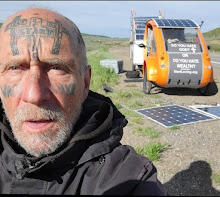
Oh, I say, I've heard that line before. Ah, they say, but you haven't seen this car before. It's a plug-in electric car that is also powered by rooftop solar panels — and the two young women, recent Yale grads, had just driven it all over India in a "climate caravan" to highlight the solutions to global warming being developed by Indian companies, communities, campuses and innovators, as well as to inspire others to take action.

They ask me if I want to drive, but I have visions of being stopped by the cops and ending up in a New Delhi jail. Not to worry, they tell me. Indian cops have been stopping them all across India. First, they ask to see driver's licenses, then they inquire about how the green car's solar roof manages to provide 10 percent of its mileage — and then they try to buy the car.

We head off down Panchsheel Marg, one of New Delhi's main streets. The ladies want to show me something. The U.S. Embassy and the Chinese Embassy are both located on Panchsheel, directly across from each other. They asked me to check out the rooftops of each embassy. What do I notice? Let's see ... The U.S. Embassy's roof is loaded with antennae and listening gear. The Chinese Embassy's roof is loaded with ... new Chinese-made solar hot-water heaters.

You couldn't make this up.

But trying to do something about it was just one of many reasons my hosts, Caroline Howe, 23, a mechanical engineer on leave from the Yale School of Forestry and Environmental Studies, and Alexis Ringwald, a Fulbright scholar in India and now a solar entrepreneur, joined with Kartikeya Singh, who was starting the Indian Youth Climate Network, or IYCN, to connect young climate leaders in India, a country coming under increasing global pressure to manage its carbon footprint.

"India is full of climate innovators, so spread out across this huge country that many people don't get to see that these solutions are working right now," said Howe. "We wanted to find a way to bring people together around existing solutions to inspire more action and more innovation. There's no time left to just talk about the problem."

Howe and Ringwald thought the best way to do that might be a climate solutions road tour, using modified electric cars from India's Reva Electric Car Company, whose C.E.O. Ringwald knew. They persuaded him to donate three of his cars and to retrofit them with longer-life batteries that could travel 90 miles on a single six-hour charge — and to lay on a solar roof that would extend them farther.

Between Jan. 1 and Feb. 5, they drove the cars on a 2,100-mile trip from Chennai to New Delhi, stopping in 15 cities and dozens of villages, training Indian students to start their own climate action programs and filming 20 videos of India's top home-grown energy innovations. They also brought along a solar-powered band, plus a luggage truck that ran on plant oil extracted from jatropha and pongamia, plants locally grown on wasteland. A Bollywood dance group joined at different stops and a Czech who learned about their trip on YouTube hopped on with his truck that ran on vegetable-oil waste.

Deepa Gupta, 21, a co-founder of IYCN, told The Hindustan Times that the trip opened her eyes to just how many indigenous energy solutions were budding in India — "like organic farming in Andhra Pradesh, or using neem and garlic as pesticides, or the kind of recycling in slums, such as Dharavi. We saw things already in place, like the Gadhia solar plant in Valsad, Gujarat, where steam is used for cooking and you can feed almost 50,000 people in one go." (See: www.indiaclimatesolutions.com.)

At Rajpipla, in Gujarat, when they stopped at a local prince's palace to recharge their cars, they discovered that his business was cultivating worms and selling them as eco-friendly alternatives to chemical fertilizers.

I met Howe and Ringwald after a tiring day, but I have to admit that as soon as they started telling me their story it really made me smile. After a year of watching adults engage in devastating recklessness in the financial markets and depressing fecklessness in the global climate talks, it's refreshing to know that the world keeps minting idealistic young people who are not waiting for governments to act, but are starting their own projects and driving innovation.

"Why did this tour happen?" asked Ringwald. "Why this mad, insane plan to travel across India in a caravan of solar electric cars and jatropha trucks with solar music, art, dance and a potent message for climate solutions? Well ... the world needs crazy ideas to change things, because the conventional way of thinking is not working anymore."


Does a Big Economy Need Big Power Plants? A Guest Post


By Stephen J. Dubner February 9, 2009, 3:49 pm

http://freakonomics.blogs.nytimes.com/2009/02/09/does-a-big-economy-need-big-power-plants-a-guest-post/

INSERT DESCRIPTIONAmory Lovins

Amory B. Lovins is the energy maven's energy maven, viewed variously as a visionary or a heretic in his assessments of how the U.S. and the world should be generating and using energy. More specifically, he is the chairman and chief scientist at the Rocky Mountain Institute, a man who has won many awards, written many books, and, as if that weren't enough, was a fan favorite for Energy Secretary when we asked blog readers a few months ago to give incoming President Obama some advice.

Lovins has written a guest post for us today, which I am guessing that everyone who cares about energy will find instructive in one way or another. It is especially interesting in light of forward-looking projects like this one about battery-exchange stations for electric cars — for as eager as we may be to wean ourselves from oil, it's worth remembering that all that newly-demanded electricity doesn't grow on trees.

Does a Big Economy Need Big Power Plants?
By Amory B. Lovins
A Guest Post

If I told you, "Many people need computing services, so we'd better build more mainframe computer centers where you can come run your computing task," you'd probably reply, "We did that in the 1960's, but now we use networked PC's." Or if I said, "Many people make phone calls, so we'd better build more big telephone exchanges full of relays and copper wires," you'd exclaim, "Where have you been? We use distributed packet-switching."

Yet if I said, "Many people need to run lights and motors, Wii's, and air conditioners, so we'd better build more giant power plants," you'd probably say, "Of course! That's the only way to power America."

Thermal power stations burn fuel or fission atoms to boil water to turn turbines that spin generators, making 92 percent of U.S. electricity. Over a century, local combined-heat-and-power plants serving neighborhoods evolved into huge, remote, electricity-only generators serving whole regions. Electrons were dispatched hundreds of miles from central stations to dispersed users through a grid that the National Academy of Engineering ranked as its profession's greatest achievement of the 20th century.

This evolution made sense at first, because power stations were costlier and less reliable than the grid, so by backing each other up through the grid and melding customers' diverse loads, they could save capacity and achieve reliability. But these assumptions have reversed: central thermal power plants now cost less than the grid, and are so reliable that about 98 percent to 99 percent of all power failures originate in the grid. Thus the original architecture is raising, not lowering, costs and failure rates: cheap and reliable power must now be made at or near customers.

"Central thermal stations have become like Victorian steam locomotives: magnificent technological achievements that served us well until something better came along."

Power plants also got irrationally big, upwards of a million kilowatts. Buildings use about 70 percent of U.S. electricity, but three-fourths of residential and commercial customers use no more than 1.5 and 12 average kilowatts respectively. Resources better matched to the kilowatt scale of most customers' needs, or to the tens-of-thousands-of-kilowatts scale of typical distribution substations, or to an intermediate "microgrid" scale, actually offer 207 hidden economic advantages over the giant plants. These "distributed benefits" often boost economic value by about tenfold. The biggest come from financial economics: for example, small, fast, modular units are less risky to build than big, slow, lumpy ones, and renewable energy sources avoid the risks of volatile fuel prices. Moreover, a diversified portfolio of many small, distributed units can be more reliable than a few big units.

Bigger power plants' hoped-for economies of scale were overwhelmed by diseconomies of scale. Central thermal power plants stopped getting more efficient in the 1960's, bigger in the 1970's, cheaper in the 1980's, and bought in the 1990's. Smaller units offered greater economies from mass production than big ones could gain through unit size. In the 1990's, the cost differences between giant nuclear plants — gigantism's last gasp — and railcar-deliverable, combined-cycle, gas-fired plants derived from mass-produced aircraft engines, created political stresses that drove the restructuring of the utility industry.

Meanwhile, generators thousands or tens of thousands of times smaller — microturbines, solar cells, fuel cells, wind turbines — started to become serious competitors, often enabled by IT and telecoms. The restructured industry exposed previously sheltered power-plant builders to brutal market discipline. Competition from a swarm of smaller electrical sources and savings created financial risks far beyond the capital markets' appetite. Moreover, the 2008 Defense Science Board report "More Fight, Less Fuel" advised U.S. military bases to make their own power onsite, preferably from renewables, because the grid is vulnerable to long and vast disruptions.

Big thermal plants' disappointing cost, efficiency, risk, and reliability were leading their orders to collapse even before restructuring began to create new market entrants, unbundled prices, and increased opportunities for competition at all scales. By now, the world is shifting decisively to "micropower" — The Economist's term for cogeneration (making electricity and useful heat together in factories or buildings) plus renewables (except big hydroelectric dams).

The U.S. lags with only about 6 percent micropower: its special rules favor incumbents and gigantism. Yet micropower provides from one-sixth to more than half of all electricity in a dozen other industrial countries. Micropower in 2006 (the last full data available) delivered a sixth of the world's total electricity (more than nuclear power) and a third of the world's new electricity. Micropower plus "negawatts" — electricity saved by more efficient or timely use — now provide upwards of half the world's new electrical services. The supposedly indispensable central thermal plants provide only the minority, because they cost too much and bear too much financial risk to win much private investment, whereas distributed renewables got $91 billion of new private capital in 2007 alone. Collapsed capital markets now make giant projects even more unfinanceable, favoring lower-financial-risk granular projects even more.

In short, many, even most, new generating units in competitive market economies have already shifted from the million-kilowatt scale of the 1980's to the hundredfold-smaller scale that prevailed in the 1940's. Even more radical decentralization, all the way to customers' kilowatt scale (prevalent in and before the 1920's), is rapidly emerging and may prove even more beneficial, especially if its control intelligence becomes distributed too.

Global competition between big and small plants is turning into a rout. In 2006, nuclear power worldwide added 1.44 billion watts (about one big reactor's worth) of capacity — more than all of it from uprating old units, since retirements exceeded additions. But that was less capacity than photovoltaics (solar cells) added in 2006, or a tenth what windpower added, or 2.5 percent to 3 percent of what micropower added. China's nuclear program, the world's most ambitious, achieved one-seventh the capacity of its distributed renewable capacity and grew one-seventh as fast. In 2007, the U.S., Spain, and China each added more wind capacity than the world added nuclear capacity, and the U.S. added more wind capacity than it added coal-fired capacity during 2003 to 2007 inclusive.

What part of this story does anyone who takes markets seriously not understand? Central thermal stations have become like Victorian steam locomotives: magnificent technological achievements that served us well until something better came along. When today's billion-watt, multi-billion-dollar plants retire, we won't replace them with more of the same. I'm already experiencing a whiff of prenostalgia.


WP: Scientists: Pace of Climate Change Exceeds Estimates

washingtonpost.com
http://www.washingtonpost.com/wp-dyn/content/article/2009/02/14/AR2009021401757_pf.html

By Kari Lydersen
Washington Post Staff Writers
Sunday, February 15, 2009; A03

CHICAGO, Feb. 14 -- The pace of global warming is likely to be much faster than recent predictions, because industrial greenhouse gas emissions have increased more quickly than expected and higher temperatures are triggering self-reinforcing feedback mechanisms in global ecosystems, scientists said Saturday.

"We are basically looking now at a future climate that's beyond anything we've considered seriously in climate model simulations," Christopher Field, founding director of the Carnegie Institution's Department of Global Ecology at Stanford University, said at the annual meeting of the American Association for the Advancement of Science.

Field, a member of the United Nations' Intergovernmental Panel on Climate Change, said emissions from burning fossil fuels since 2000 have largely outpaced the estimates used in the U.N. panel's 2007 reports. The higher emissions are largely the result of the increased burning of coal in developing countries, he said.

Unexpectedly large amounts of carbon dioxide are being released into the atmosphere as the result of "feedback loops" that are speeding up natural processes. Prominent among these, evidence indicates, is a cycle in which higher temperatures are beginning to melt the arctic permafrost, which could release hundreds of billions of tons of carbon and methane into the atmosphere, said several scientists on a panel at the meeting.

The permafrost holds 1 trillion tons of carbon, and as much as 10 percent of that could be released this century, Field said. Melting permafrost also releases methane, which is 25 times more potent a greenhouse gas than carbon dioxide.

"It's a vicious cycle of feedback where warming causes the release of carbon from permafrost, which causes more warming, which causes more release from permafrost," Field said.

Evidence is also accumulating that terrestrial and marine ecosystems cannot remove as much carbon from the atmosphere as earlier estimates suggested, Field said.

In the oceans, warmer weather is driving stronger winds that are exposing deeper layers of water, which are already saturated with carbon and not as able to absorb as much from the atmosphere. The carbon is making the oceans more acidic, which also reduces their ability to absorb carbon.

On land, rising carbon dioxide levels had been expected to boost plant growth and result in greater sequestration of carbon dioxide. As plants undergo photosynthesis to draw energy from the sun, carbon is drawn out of the atmosphere and trapped in the plant matter. But especially in northern latitudes, this effect may be offset significantly by the fact that vegetation-covered land absorbs much more of the sun's heat than snow-covered terrain, said scientists on the panel.

Earlier snowmelt, the shrinking arctic ice cover and the northward spread of vegetation are causing the Northern Hemisphere to absorb, rather than reflect, more of the sun's energy and reinforce the warming trend.

While it takes a relatively long time for plants to take carbon out of the atmosphere, that carbon can be released rapidly by wildfires, which contribute about a third as much carbon to the atmosphere as burning fossil fuels, according to a paper Field co-authored.

Fires such as the recent deadly blazes in southern Australia have increased in recent years, and that trend is expected to continue, Field said. Warmer weather, earlier snowmelt, drought and beetle infestations facilitated by warmer climates are all contributing to the rising number of fires linked to climate change. Across large swaths of the United States and Canada, bark beetles have killed many mature trees, making forests more flammable. And tropical rain forests that were not susceptible to forest fires in the past are likely to become drier as temperatures rise, growing more vulnerable.

Preventing deforestation in the tropics is more important than in northern latitudes, the panel agreed, since lush tropical forests sequester more carbon than sparser northern forests. And deforestation in northern areas has benefits, since larger areas end up covered in exposed, heat-reflecting snow.

Many scientists and policymakers are advocating increased incentives for preserving tropical forests, especially in the face of demand for clearing forest to grow biofuel crops such as soy. Promoting biofuels without also creating forest-preservation incentives would be "like weatherizing your house and deliberately keeping your windows open," said Peter Frumhoff, chief of the Union of Concerned Scientists' climate program. "It's just not a smart policy."

Field said the U.N. panel's next assessment of Earth's climate trends, scheduled for release in 2014, will for the first time incorporate policy proposals. It will also include complicated models of interconnected ecosystem feedbacks.

The panel's last report noted that preliminary knowledge of such feedbacks suggested that an additional 100 billion to 500 billion tons of greenhouse gas emissions would have to be prevented in the next century to avoid dangerous global warming. Currently, about 10 billion tons of carbon are emitted each year.

 
<<<Http://HomeearthSecurity.blogspot.com