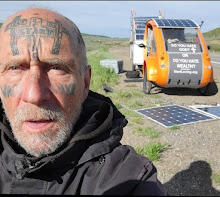
Friday, February 13, 2009

RELEASE: STRIKE TO CUT WAR FUND PEACE $200B FAST ENDED IN PREPARATION FOR NEXT CAMPAIGN

February 13, 2009 Washington DC.  Start Loving announced the conclusion of a fast begun December 19th to redirect tax payer funds from war making to peace building (NewsBlaze Jan. 3, 2009).  Start Loving, a long time peace and social justice activist,  stated, "I'm asked all the time if hunger strikes make a difference?  I believe every action makes a difference.  Only the direction and degree are in question. Now would Barney Frank be taking as courageous a stand on cutting the military budget had his office not witnessed the Hunger Strike and my Occupation on Capitol Hill these last two months, ("Cut the Military Budget,," Barney Frank, The Nation 2/13/09)? That I'll never know." 

Diane Wilson, another activist who joined the hunger strike weeks later from her home in Texas after Start loving began the strike and  round the clock occupation of Capital Hill on December 19, said, "Our action is informed by what Gandhi called for, 'Be the change you wish to see.'  We cannot expect courageous action from others unless we citizens live it ourselves. This especially applies to Congress"

On day 35 of  the Hunger Strike and after many positive moves by the Obama administration came into view, Wilson and Loving went into "hold" mode - half rations. Today, Start said he was concluding the campaign because Congress, the target audience, was going home for a week and also positive moves continue come from the Obama administration, and from many Democrats on the Hill.

Loving stated, "With the Congress away we will use the time to regain strength for the next leg of the battle.  I expect, however, to spend  many more months on the Hill lobbying for sanity.  With the economy in shambles, it is insane for the US to spend $1 trillion on war-making.  Just yesterday, Russia announced they are cutting their  $45 billion budget by 15% due to their financial crisis. We should be doing the same. Now."
 
<<<Http://HomeearthSecurity.blogspot.com

Your brother in Peace-Building,

Start Loving
...
WAGE LOVE OR DIE (NO 3RD OPTION ANY LONGER EXISTS).
GANDHI:   "BE THE [COURAGEOUS LEADERSHIP] YOU WISH TO SEE."
Http://AmericasBleedingWars.blogspot.com


Http://Start-Loving.blogspot.com 
Http://youtube.com/StartLoving1  


Utah Antelope Creek tar sands oil project; Sierra Club Partners with Indigenous Environmental Network


By by the Indigenous Environmental Network,


http://thecirclenews.org/index.php?option=com_content&task=view&id=91&Itemid=1

The Sierra Club and the Indigenous Environmental Network are fighting a project that would bring one of the dirtiest forms of energy extraction in the world to eastern Utah.

The proposed Antelope Creek tar sands oil project threatens to disrupt wildlife, poison and dry up rivers, and harm human health with hazardous air pollutants. The project would also produce an exorbitant amount of the greenhouse gases that cause global warming.   

In an effort to prevent these impacts, the groups filed a lawsuit in Utah federal district court this January. The suit challenges approval of the tar sands project by the U.S. Bureau of Indian Affairs, which manages the land slated for the development.   

"Tar sands oil is one of the world's dirtiest forms of energy," said Utah Sierra Club representative Wayne Hoskisson. "This project would suck rivers dry, poison water, pollute the air, and threaten fish and wildlife. At a time when the whole world is turning to clean energy, it doesn't make sense to encourage such a wasteful and dangerous source of fuel."   

The Antelope Creek tar sands project, proposed by Petroglyph Gas Partners, would drill 300 new wells within 720 acres of land, using deep injection thermal extraction techniques. The project site is home to 13 species proposed or listed under the Endangered Species Act, and an extensive network of creeks that drain into the Duchesne and Green Rivers.

Both mining and processing of tar sands cause significant environmental impacts, including huge emissions of global warming gases, destruction of wildlife habitat, and impacts to air and water quality. In addition to producing greenhouse gas emitting fossil fuels, tar sands development is significantly more energy intensive than conventional oil and gas development.

Greenhouse gas emissions from tar sands production are three times those of conventional oil and gas production, and producing synthetic crude oil emits up to 20% more greenhouse gas emissions than low-sulfur, light crude oils. Tar sands development, which largely has been concentrated in Canada, is becoming the country's largest single emitter of greenhouse gases. In the United States growing interest in tar sands development, especially in the western states, could increase U.S. greenhouse gas emissions from new tar sands projects from 27 to 126 million tons by 2015.

In addition, large quantities of water are required for tar sands extraction operations and would draw down surface water flow, adversely impacting stream habitat for fish and other species dependant on local water resources. Drilling one well consumes 5.5 acre-feet of water each year, and the production of one gallon of oil requires thirty-five gallons.

Tar sands are composed of clay, sand, water, and bitumen, a heavy black viscous oil, which can be mined and processed. Extracted bitumen is then refined into synthetic oil and other petroleum products. Because the bitumen cannot be pumped from the ground in its natural state, deposits are mined using energy intensive extraction and separation techniques to separate bitumen from the sand, clay and water. Surface tar sand deposits can be recovered by open pit mining techniques, using large hydraulic and electrically powered shovels to dig up tar sands and transport them for extraction using a hot water separation process. Compressed air and steam injection methods are used to extract deep tar sand deposits, and those methods require large quantities of water and energy for heating and pumping. About two tons of tar sands are required to produce one barrel of oil.

Tar sands activities, including grading, excavation and extraction, emit a number of hazardous air pollutants that pose health risks to employees and nearby residents. Greenhouse gas emissions from tar sands production are three times those of conventional oil and gas production.
Tar sands development, which largely has been concentrated in Canada, is becoming that country's largest single emitter of greenhouse gases and is widely regarded as an environmental disaster.    
"In our work on the Canadian tar sands development we've learned that this type of fossil fuel development is very harmful to human health and has contaminated water resources," said Jihan Gearon of the Indigenous Environmental Network.

"It is the BIA's responsibility to protect the trust assets of Tribes. By trying to allow this proposal to move forward on the basis of an outdated and inadequate environmental assessment, the BIA is failing in its fiduciary responsibility to ensure the environment and well being of the local Ute tribe is protected," Gearon said.

Thursday, February 12, 2009

Hillary Clinton's climate-saving voyage

http://www.csmonitor.com/2009/0213/p08s01-comv.html

To help Obama win a Senate vote on emission caps, she needs to have China take action on global warming, too.

from the February 13, 2009 edition


Hillary Clinton chose Asia, particularly China, for her maiden voyage next week as secretary of State. While the most urgent issue is Beijing's help to end a global recession, Mrs. Clinton's more planet-saving goal is to enlist China to set curbs on its carbon emissions. Without that, President Obama may not be able to win enough Senate votes for a cap on US greenhouse gases.

As the world's two largest emitters, China and the US will set the pace this year among all nations in make-or-break negotiations for a post-Kyoto treaty on global warming. The talks end this December with a summit in Copenhagen.

If the world is to make a commitment to fight climate change, each of these giant polluters needs to know the other will jump into the same chilly pool of obligatory curbs on their tailpipes and smokestacks.

But if China isn't making much of a sacrifice, many US senators, especially those from coal states, may not support CO2 cuts or a treaty seen as reducing US competitiveness. China says it and other developing countries deserve to be allowed to pollute for a while to catch up to modern standards.

Mrs. Clinton must break this standoff. The bleak future that each country faces in a warming planet isn't all that different. And working together on climate change might even draw them closer.

Both countries have taken a long time to wake up to the task. Mr. Obama's election ushers in a drive for a "green" economy. And since 2005, Beijing has made some efforts to rein in its worst polluters, if only for the sake of not letting the local damage hinder growth or to quell rising environmental protests that challenge the party itself.

But China has two problems that may keep it from satisfying the US.

Rather than slow its economy with emission caps, it wants the West to give it advanced energy technology, such as "clean" coal plants. That's a cost the US may not be willing to bear given the energy investments it needs.

The second is that the Communist Party, despite its green intentions, seems unable to control local chiefs in the provinces who are rewarded for growth and often ignore party mandates. And many of them are part owners in polluting factories.

A top-down campaign against CO2 is likely to fail. Until Beijing allows local democracy – and full freedom for citizen activists – there won't be enough public pressure on these local chiefs.

While Beijing has tolerated a blossoming of environmental groups since 1994, it keeps a rein on them, fearing they may spark a "green" revolt against the regime. Clinton needs to push China to loosen those reins and allow political and media freedom.

She can start by asking for the release of Wu Lihong, a prominent activist who was given a three-year sentence in 2007 after leading a campaign against pollution in the home province of President Hu Jintao. His release would signal a new freedom for eco-advocacy.

Just as millions of Americans now pressure their leaders for action on global warming, China needs millions of courageous activists like Wu Lihong.

For want of a dissident released, a planet should not be lost.


Big Science Role Is Seen in Global Warming Cure

http://www.nytimes.com/2009/02/12/us/politics/12chu.html?ref=us
 
The New York Times
February 12, 2009

WASHINGTON — Steven Chu, the new secretary of energy, said Wednesday that solving the world's energy and environment problems would require Nobel-level breakthroughs in three areas: electric batteries, solar power and the development of new crops that can be turned into fuel.

Dr. Chu, a physicist, spoke during a wide-ranging interview in his office, where his own framed Nobel Prize lay flat on a bookcase, a Post-it note indicating where it should be hung on the wall.

He addressed topics that included global warming, renewable energy sources like solar and wind power, the use of coal and a proposed repository for nuclear waste at Yucca Mountain in Nevada.

Dr. Chu said a "revolution" in science and technology would be required if the world is to reduce its dependence on fossil fuels and curb the emissions of carbon dioxide and other heat-trapping gases linked to global warming.

Solar technology, he said, will have to get five times better than it is today, and scientists will need to find new types of plants that require little energy to grow and that can be converted to clean and cheap alternatives to fossil fuels.

Dr. Chu, who once called coal "a nightmare" in the way it is currently used, said the United States must also lead the world in finding a way to burn the fuel cleanly, because other countries with big coal reserves, like India and China, will not turn away from coal.

But Dr. Chu said such developments were not impossible. At the turn of the last century, he noted, scientists like Fritz Haber and Carl Bosch made Nobel-winning discoveries that allowed the development of cheap nitrogen fertilizers, saving Europe from starvation.

"I think science and technology can generate much better choices," Dr. Chu said. "It has, consistently, over hundreds and hundreds of years."

Dr. Chu said members of Congress who are drafting legislation to limit emissions of global warming gases had not yet sought his advice, although he added, "I would expect that they might."

He said that while President Obama and Congressional Democratic leaders had endorsed a so-called cap-and-trade system to control global warming pollutants, there were alternatives that could emerge, including a tax on carbon emissions or a modified version of cap-and-trade.

Dr. Chu said reaching agreement on legislation to combat climate change would be difficult in the current recession because any scheme to regulate greenhouse gas emissions would probably cause energy prices to rise and drive manufacturing jobs to countries where energy is cheaper.

"The concern about cap-and-trade in today's economic climate," Dr. Chu said, "is that a lot of money might flow to developing countries in a way that might not be completely politically sellable."

But, he said, he supports putting a price on carbon emissions to begin to address climate change.

The Energy Department is involved with efforts as varied as developing nuclear weapons and sequencing the human genome. Dr. Chu said the department's nuclear weapons program, which the White House is considering moving to the Defense Department, should be more tightly coupled to science in critical tasks like safeguarding nuclear materials and detecting nuclear proliferation.

One major decision facing his department is what to do about Yucca Mountain, a site 100 miles from Las Vegas chosen by Congress for burial of high-level radioactive waste. Mr. Obama and the Senate majority leader, Harry Reid of Nevada, have opposed the project.

Dr. Chu said the political difficulties in trying to obtain a license for the Yucca Mountain site should serve as a guide in searching for other nuclear waste repositories in the future. "There are political realities," he said.

Last year, the Nuclear Regulatory Commission, which has the final say, began work on an application from the Energy Department for a license for the project. Dr. Chu said the Energy Department should continue to answer questions from the Nuclear Regulatory Commission about the application and then let the commission make a decision.

Dr. Chu would not say whether the department would open the site if allowed to do so. But, he said, "you can put a hold on" preparation.

The electric utilities, he noted, expected the department to live up to contracts signed in the 1980s for it to dispose of the nuclear waste.

Dr. Chu said he was still adjusting to his surroundings and title after most of a career spent as an academic scientist. Asked whether he preferred to be called "Dr. Chu" or "Mr. Secretary," he answered, "Steve is fine."


Roselle's Goal: End Mountaintop Mining

http://wowktv.com/story.cfm?func=viewstory&storyid=52024

 Roselle's Goal: End Mountaintop Mining
Posted Thursday, February 12, 2009 ; 09:36 AM | View Comments | Post Comment
Updated Thursday, February 12, 2009 ; 03:44 PM


Environmentalist made headlines in the '80s and '90s as the founder of Earth First!

Story by Gretchen Mae Stone
Email | Bio | Other Stories by Gretchen Mae Stone

ROCK CREEK  -- Just a few months ago, three little coal company houses stood along the Coal River, gutted and near the end of their lives.

Now, those three little homes are considered the Appalachian base for Climate Ground Zero and Coal River Wind. Their new tenant, 54-year-old national environmentalist Mike Roselle, is setting up shop to get ready for a long summer of disobedience in the coalfields.

But he's used to that.

Roselle started his life on the road as a yippie/lowbagger at 16, leaving Louisville, Ky., to first protest against the Vietnam War and then any supposed-environmental wrongs he felt needed righted.

Lowbaggers are part of a loosely tied alternative community that shares resources when living and traveling together.

Yippie is a term created by Abbie Hoffman and Jerry Rubin, both of whom Roselle said he met in those early Vietnam protests. The Youth International Party (YIP!) merged hippie counterculture and New Left activities, according to UrbanDictionary.com.

Later, Roselle was the founder of Earth First!, an environmental movement that has made headlines across the nation in the 1980s, '90s and this decade for its nontraditional and sometimes aggressive attempts to protect wilderness.

Some areas where Earth First! members have been active recently, according to the group's Web site, include a tree-sit protesting development on Vancouver Island, British Columbia; protests of drilling in the Arctic National Wildlife Refuge in Alaska; and trying to stop seal slaughter in Canada.

Now, Roselle has turned his attention to Appalachia, with the goal of ending mountaintop mining.

A few months ago, Roselle quietly moved to the Ford Addition, a cluster of homes across a small bridge just down the road from Marfork Coal Co. near Rock Creek in Raleigh County. The arrival of such a famous environmental activist went unnoticed by most media and townspeople.

That changed Feb. 3, when Roselle and 12 others chained themselves to a Massey Energy Corp. bulldozer at a mine site on Coal River Mountain in Raleigh County. He was detained and cited, but not arrested, in his first direct action in West Virginia.

His newest group, Climate Ground Zero, is small. Only he and a few nuclear members moved to town. But that's how it's always been for his grassroots efforts.

His disobedience may be nonviolent, but it's unlawful all the same. Roselle has been arrested about 40 times for civil disobedience actions, such as trespassing and chaining himself to equipment.

Roselle said he and other Climate Group Zero members plan to help end mountaintop removal mining with such actions. More importantly, they want to end it through the courts. He has long taken the legal route to protect natural resources he sees as public lands, even if privately owned.

"If you have the law on your side, you should use the law. If you can't get the law on your side, you need to change the law," he said.

When he founded Earth First!, Roselle described it as "a painfully small group." One of the group's first actions featured him and his roommate headed from California to Oregon in 1982, where logging had started in a wilderness area.

He said Earth First!'s first meeting had about 40 people in attendance and then 20 at the second. At their first action, about eight people came and four were arrested. In 12 separate actions from April to July of that year, about 85 people were arrested. At that time, he said, none of the more traditional conservation groups would go in with Earth First! members on the 14-mile hike up a couple thousand feet of vertical elevation to the protest site. For some Earth First! activists, it was their first time in the state. It was the first time direct action and civil disobedience had been used in an organized long-term campaign, Roselle said.

"So that campaign resulted in probably a couple 100,000 acres of old-growth (forest) being protected, and from then Earth First! grew into a national organization," he said.

In larger campaigns, he has had up to 10,000 activists in attendance, with celebrities such as Bonnie Raitt and Don Henley there to help, Roselle said.

Since his beginnings in the environmental movement, Roselle has been part of Earth First!, the Rainforest Action Network, Greenpeace, the Ruckus Society and Climate Ground Zero, among others. He at one time sat on 12 environmental groups' boards, but he now focuses on consulting and, for the time being, ending mountaintop removal.

In his years of direct-action experience, Roselle said, he has always practiced nonviolence methods to forward the environmental movement.

But some Web sites insist Roselle was spiking trees as a member of Earth First! in its early days. Some media reports said Roselle has made statements urging others to do the same.

A copy of Earth First! journal purported to contain the quote was not immediately available as of press time.

That quote, reads in part, "This is jihad, pal. Everything, every assumption, every institution needs to be challenged. Now! And more spiking is needed to convey the urgency of the situation!... Go out and get them suckers, fill them full of steel, and I promise you this: you might get caught; you might do some time; your friends might abandon you. But you will never have to spike the same tree twice."

Roselle insists, however, that he has never spiked a tree.

He said the movement to spike trees was a small one, and that, like a union movement, it was sometimes violent when irate people took such action.

"It was never done in any organized way, and in most cases the people who did it were anonymous," he said.

Tree-spiking instances were rare, he said, and generally became overblown.

"It occurred, and I do know people who have been involved in it; that movement is not that big," he said. "The only reason I knew they were involved in it was after they were arrested, and I'd read about it in the papers."

The Ruckus Society Web site lists Roselle as one of two "infamous nonviolence practitioners," who founded the group. That group is dedicated to training activists in nonviolent forms of civil disobedience, Roselle said.

Copyright 2009 West Virginia Media. All rights reserved. This material may not be published, broadcast, rewritten, or redistributed.


China thirsts under drought, water waste MONSTERS.CRITICS

From Monsters and Critics.com

Asia-Pacific Features
China thirsts under drought, water waste (Feature)
By Andreas Landwehr
Feb 12, 2009, 3:44 GMT

   Beijing - It is not just the worst drought in five decades that makes China reel under under water insufficiency.

   Too many people in the world's most populous country are consuming rapidly diminishing water resources at an accelerating pace. Utter waste, together with inefficient use of water reserves exacerbate the crisis.

   Chinese and foreign experts have been sounding the alarm for considerable time as rivers and lakes dry out and ground water levels fall, while climate change causes glaciers to melt at an ever faster pace.

   At the same time, water pollution is worsening dramatically.

   'China faces a major challenge in managing its scarce water resources to sustain economic growth in the years ahead. This is a daunting task,' said the World Bank's recent Cost of Pollution in China study.

   The water crisis is already costing China about 2.3 per cent of its gross domestic product, according to a World Bank estimate.

   More than 300 million people in the countryside have no access to clean and safe drinking water, diseases like cancer and diarrhea are on the rise among children.

   Some 400 of China's 660 largest cities lack sufficient water supplies, with the situation being particularly bad in metropolises like Beijing and Tianjin.

   Beijing has had no rain for more than 100 days, with 15 provinces suffering from the worst drought in decades this winter.

   Many cities and towns have declared a state of emergency as the harvest on 10 million hectares of farm land is endangered.

   'It looks pretty serious,' said Lester Brown of the Earth Policy Institute in Washington, DC.

   He added the winter wheat harvest, which accounts for 90 per cent of the country's entire harvest, would definitely be down from last year. Brown said he had seen studies ranging from 2 to 20 per cent less.

   'If it is close to 20 per cent, then China will likely be coming into the world market for wheat imports,' he said.

   The result would be higher prices along with an exacerbation of the global food crisis.

   But China not only has to tackle the current drought, but also long-term general water scarcity.

   With just 7 per cent of the world's fresh water reserves at its disposal the country has to supply 20 per cent of the global population.

   As four fifths of these reserves are concentrated in the south, northern China is in a particularly bad position, although the region harbours two thirds of all farmed land, which must be irrigated.

   Almost all of the water needed for irrigation is pumped up through wells.

   As a result of this excessive pumping, the ground water level in the Hai river basin has subsided between 50 and 90 metres, in Beijing even by between 100 to 300 metres.

   'On the one hand we have drought and insufficient drinking water, on the other an incredible waste of existing resources,' criticized China's deputy minister for water management, E Jingping.

   The sorry state of irrigation systems results in only 45 per cent of the pumped water actually reaching the fields.

   China's agricultural industry consumes two thirds of all water available, although the sector contributed only one eighth to the country's GDP, explained the minister.

   And demand by farmers is poised to rise another 60 per cent by 2030, according to experts.

   Even China's manufacturing industry consumes between three and 10 times the amount of water than its counterparts in developed countries.

   Only some 40 per cent of industrial waste water is treated, while western countries manage treating between 75 and 85 per cent.

   The country's average, including human sewage treatment, accounts for just 56 per cent.

   In addition, increasing water contamination and pollution through chemical fertilizers, pesticides and livestock waste is difficult to control.

   But despite the apparent crisis, the 1.3 billion Chinese are still wasting water as if it would be inexhaustible.

   One of the reasons for this thoughtlessness is the antiquated water distribution scheme introduced by the Communists, which makes water extremely cheap.

   Because of that, the World Bank recommended a radical reform of water management practices in China including the adoption of water saving technologies and behavior, an adjustment of water prices, a clear definition of water ownership rights, and tougher environmental protection laws.

   'Water prices need to be allowed to rise to reflect its full scarcity value,' recommended the World Bank study.

   'The first step is for water and sewerage prices to at least cover the financial needs of the water supply and sewerage enterprises,' the report added.


© Copyright 2007 by monstersandcritics.com.
This notice cannot be removed without permission.


Wednesday, February 11, 2009

NYT: Q&A: Energy Independence, Obama and Canada’s Oil Sands

http://greeninc.blogs.nytimes.com/2009/02/09/qa-energy-independence-obama-and-canadas-oil-sands/
February 9, 2009, 6:29 am

Q&A: Energy Independence, Obama and Canada's Oil Sands

"There are two perspectives on the oil sands," the author Andrew Nikiforuk says. "You have companies that want to make it the next Saudi Arabia. The other is that it's a transitional resource to a low-carbon economy."

Andrew Nikiforuk, a journalist based in Calgary, has closely followed the development of northern Alberta's massive deposits of bitumen — a heavy black oil impregnating the sand and soil over hundreds of square miles northeast of Edmonton.


The oil sands, or tar sands, as they are sometimes known, must undergo rigorous processing to extract useable oil — an expensive and dirty undertaking that becomes more attractive to developers as oil prices climb, and less so as they fall.


The province saw unprecedented growth at the oil sands over the last decade, but low global oil prices have now stalled Alberta's bitumen boom.


In his 2008 book, "Tar Sands: Dirty Oil and the Future of a Continent," Nikiforuk offers a scathing critique of what he calls the corporate greed and regulatory indifference that have attended development of Canada's vast oil patch. Mr. Nikiforuk spoke with Green Inc. recently about how President Barack Obama, who has promised to pursue energy independence for the United States and who is expected to make a state visit to Canada later this month, might regard the tar sands.

***

Do you expect the Obama administration to change in the way the oil sands are regarded as a continental resource?


It's not clear. George Bush and Dick Cheney saw the resource as a pillar of economic activity and energy security for the United States. But the tar sands have delivered neither security nor sustainability. How [President Obama] deals with the rapid development of the tar sands will pretty much indicate how serious he is about a switch to alternative and renewable energies.

You talk about the oil sands as being a transitional resource to a low-carbon economy. Do you think there's any recognition of this notion in the new administration?


There is among people like Henry Waxman, chairman of the energy committee in the U.S. Congress. But, again there's no indication the Obama administration gets this point. There are two perspectives on the oil sands. You have companies that want to make it the next Saudi Arabia. The other is that it's a transitional resource to a low-carbon economy and to regard it as anything else is to drain the continent's financial resources.


What's the impact of the current economy on the future development of the oil sands?


The slowdown is quite phenomenal. We're already looking at a withdrawal of anywhere from $50 to $100 billion in capital at the moment. It's a fantastic opportunity for both the United States and Canada to reassess the world's largest energy project. There's been virtually no clear thinking about the project in Canada. It gives the United States also an opportunity to say, O.K., we're already addicted to this resource to some degree. Much of the U.S. Midwest is already running on bitumen. Do we want to extend this addiction and at what cost? Or should we set other goals and say, one to two million barrels of oil a day from the tar sands is all we really need to make the transition?


Do you think the move towards national and possibly continental cap-and-trade systems will further that goal?


I'm not quite sure. Cap-and-trade has had a checkered career in Europe and it takes us away from the real focus, which is that maybe we shouldn't be making these emissions in the first place. Maybe we should really be focusing on smart grids, electric cars and a whole new approach to doing things. The problem with cap-and-trade and programs such as carbon capture and storage is that they all assume that business as usual can continue. The financial meltdown and peak oil has pretty much demonstrated that business as usual's not going to work.


Oil Industry Ready to Work on Global Warming

http://www.nytimes.com/2009/02/12/science/earth/12oil.html?ref=business
 
The New York Times


February 12, 2009

HOUSTON — Confronted with a sharp change of priorities in Washington, international oil executives are expressing an eagerness to work with President Obama to fashion new policies to tackle global warming.

At an industry conference here this week, the executives struck a conciliatory tone on how to limit the emissions that are contributing to climate change, with many of them sounding like budding conservationists as they stressed energy efficiency and the need to develop renewable fuels.

At the same time, they declared that the country would still need oil for a long time, and sought to persuade the new administration of the need for more drilling off the nation's coasts.

On tackling global warming, a subject that has long divided the industry, some executives said they supported a tax on carbon, while others favored a trading system like the one adopted by Europe. Almost all of them seemed reconciled to the United States' adopting some kind of climate policy, and said they were eager to work with the new administration to devise an effective energy strategy.

"President Obama comes to office with a strong commitment to tackle climate change," said Tony Hayward, the chief executive of BP. "Suddenly the challenges many of us have been wrestling with for a long time — the importance of energy security in providing economic security, and tackling the issue of climate change in a way that is commercially viable — are center stage."

During his election campaign, Mr. Obama frequently criticized big oil companies, expressed skepticism about offshore drilling, and pledged to try to replace hydrocarbons with more renewable fuels. He has made energy and environmental policy a cornerstone of both his national security and economic efforts.

The executives strongly urged the administration to open up the continental shelf for offshore drilling at the very time that the interior secretary, Ken Salazar, announced that the government would review and probably scale back the Bush administration's plan to give oil and gas drillers new rights.

Exxon Mobil, which had long been skeptical of global warming, offered its own suggestions. One of the company's top executives, Michael J. Dolan, said that Exxon would back a tax on carbon, while criticizing a so-called cap-and-trade approach.

Under the cap-and-trade formula, which has considerable momentum in Washington, the government would set a ceiling on how much carbon dioxide could be emitted into the atmosphere each year. It would then give or sell permits that companies would be allowed to trade to meet their limit. Emitting carbon dioxide at present involves no penalties in the United States, meaning that companies have little incentive to curb their pollution.

Mr. Dolan, a senior vice president at Exxon, said that a carbon tax would be simpler and less subject to manipulation than a trading system. "A carbon tax reduces policy risks for businesses and investors in a way that cap-and-trade schemes do not," Mr. Dolan said during his address at the industry conference, organized by Cambridge Energy Research Associates, a consulting firm.

"In addition," he said, "by reducing other taxes — such as income or excise taxes — we can make a carbon tax revenue-neutral and offset the impact of higher taxes on the economy."

His European counterparts, meanwhile, offered a different approach, favoring the sort of cap-and-trade system that has already taken hold in Europe.

Jeroen van der Veer, chief executive of Royal Dutch Shell, said the key was to assign a cost to carbon. "I don't lose any sleep if the United States or anyone else gets a carbon tax," Mr. van der Veer said. "The world is helped by pricing carbon dioxide, whichever way you do it."

A cap-and-trade system establishes a clear environmental goal by setting an upper limit on emissions, something a carbon tax does not necessarily do, he said. Meanwhile, the possibility of trading carbon permits provides companies with an economic incentive to invest in technologies that reduce emissions. He said that a cap-and-trade system had worked well in the United States for cutting the emissions that cause acid rain.

But he added that higher fuel taxes largely explain why European vehicles are far more efficient than American ones.

"Both can work, and even coexist," he said. "They both price CO2," or carbon dioxide.

Daniel Yergin, the chairman of Cambridge Energy Research and the organizer of the conference, said oil companies recognized that major policy changes were coming, and that they need to be a part of the debate.

"They are not arguing about basic philosophy anymore, but about practical steps," he said. "We're moving into a new era of policy making that will have very important and far-reaching implications for energy markets."


February 5, 2009 Experts in U.S. and China See a Chance for Cooperation Against Climate Change

http://www.nytimes.com/2009/02/05/world/asia/05china.html?ref=world
The New York Times


BEIJING — When Chinese officials and the Obama administration begin serious discussions over issues at the heart of relations between China and the United States, the usual suspects will no doubt emerge: trade, North Korea, human rights, Taiwan.


But an increasing number of officials and scholars from both countries say climate change is likely to become another focal point in the dialogue. American and Chinese leaders recognize the urgency of global warming, the scholars and officials say, and believe that a new international climate treaty is impossible without agreements between their nations, the world's two largest emitters of greenhouse gases.


In a sign of this new emphasis, Secretary of State Hillary Rodham Clinton plans to stress the importance of new steps on energy and global warming when she visits China, perhaps as soon as this month, an Obama administration official said.


Two reports being released Thursday propose ways for President Obama and Chinese leaders to begin addressing together, as a major priority, how to curb emissions of carbon dioxide and other greenhouse gases linked to rising temperatures.


One report, "A Roadmap for U.S.-China Cooperation on Energy and Climate Change," is a joint project of the Asia Society and the Pew Center on Global Climate Change, both based in the United States. Scientists and policy advisers from both countries contributed to the report.


The origins of the report indicate that it could carry weight in the White House. It was produced by a committee led by Steven Chu, a Nobel laureate in physics who is now the secretary of energy, and John L. Thornton, a professor at Tsinghua University who has been mentioned as a possible candidate for United States ambassador to China. John P. Holdren, Mr. Obama's choice for science adviser, is another contributor.


The report recommends that China and the United States convene a presidential summit meeting to create a broad plan to reduce greenhouse gas emissions, followed by the appointment of senior officials and independent experts to councils and task forces to develop concrete programs. It says the two governments should lay out areas for cooperation, including low-emissions coal technologies, energy efficiency and conservation, and renewable energy.


The other report, by two Brookings Institution fellows, David B. Sandalow and Kenneth G. Lieberthal, presents a menu of nine ways to build political support in both countries for sustained cooperation on cutting emissions.


In China, scholars and policy advisers who support the proposals in the "Roadmap" report say talks on energy technology and climate change could foster cooperation between the Obama administration and China. A central question is whether Chinese leaders and American lawmakers will be too focused on reviving their economies to pay serious attention to curbing emissions.


But at least in public, Prime Minister Wen Jiabao and other officials have said recently that the financial crisis gives China an opportunity to turn its growth model away from one that was not environmentally sustainable.


"I believe climate change may become a very important issue which will put China-U.S. relations in a new framework in the 21st century because the stakes are high," said Wu Jianmin, a senior adviser to the Foreign Ministry. "We all understand we don't have much time left. We've got to work together."


This largely meshes with Mr. Obama's hope for helping to revive the American economy by developing non-polluting energy technologies and "green jobs."


Todd Stern, appointed Mrs. Clinton's special envoy for climate change, said the administration hoped to end sparring between the nations over who needs to do what first.


"Secretary Clinton is keenly aware that the United States, as the largest historic emitter of greenhouse gases, and China, as the largest emitter going forward, need to develop a strong, constructive partnership to build the kind of clean-energy economies that will allow us to put the brakes on global climate change," he said in an e-mail message.


But some American officials and experts on climate and energy say that although Chinese leaders declare they are serious about the issue, it has been hard to pin them down on specifics.


Mr. Wen, in an interview with The Financial Times published Monday, restated China's position that it does not intend to agree to specific limits at a United Nations conference on climate change scheduled for December in Copenhagen.


"It's difficult for China to take quantified emission reduction quotas at the Copenhagen conference, because this country is still at an early stage of development," he said. "Europe started its industrialization several hundred years ago, but for China, it has only been dozens of years."


Gao Guangsheng, who directs the climate change office at the National Development and Reform Commission, presented a white paper in October that said the world's richest countries should contribute 1 percent of their gross domestic product to helping developing countries combat global warming.


Zhang Haibin, an associate professor at Peking University who specializes in international environmental politics, said that China and the United States had historically had weak cooperation on the climate change problem, but that Chinese leaders believed that the relationship could change under Mr. Obama.


Several American experts on energy, climate and Chinese-American relations said the "Roadmap" report built on recent calls for sustained partnerships on energy efficiency, technology for capturing carbon dioxide from power plants and other initiatives. But they said that task forces and summit meetings would be ineffective unless they led to programs and investments that continued for many years.


"Nearly everything that these two countries have tried to do jointly on climate and energy has been episodic," said David G. Victor, a political scientist at Stanford University who studies energy and climate. "The financial crisis has created an opportunity for a dialogue, but it also creates a host of new risks as the countries turn inward."


Orville Schell, a journalist who helped supervise the writing of the report as director of the Asia Society Center on U.S.-China Relations, said that in recent meetings Chinese officials had begun to recognize the need to take action on climate change.


"We have watched as officials in China have become much more receptive to the need to do 'something' about climate change, although they are still unwilling to set caps," Mr. Schell said in an e-mail message. "We have also watched our own country molt out of stubborn opposition to a far more open willingness to recognize the scientific basis of the problem and the need to do something about it."


Edward Wong reported from Beijing, and Andrew C. Revkin from New York.


US urged to save forests to curb climate change

http://www.reuters.com/article/latestCrisis/idUSN09357951


Mon Feb 9, 2009 5:24pm EST
By Deborah Zabarenko, Environment Correspondent

WASHINGTON, Feb 9 (Reuters) - The United States needs to take the lead in preserving tropical forests in the fight against climate change, a coalition of lawmakers, corporate chiefs and environmentalists said on Monday.

Deforestation accounts for 20 percent of the carbon emissions that spur global warming, members of the Avoided Deforestation Partners coalition told a Capitol Hill forum.

The U.S. Congress is expected to take up legislation this year -- possibly as soon as this month -- to tackle climate change, aiming to come up with policies that will help the United States and other countries forge a new international agreement to succeed the carbon-capping Kyoto Protocol.

"Without the leadership of the United States of America, everybody else will say, maybe this is not as serious as it seems," Wangari Maathai, the 2004 Nobel Peace Prize laureate, told the group. "If America is not concerned, then it cannot be a serious issue."

Maathai said three great tropical forests -- the Amazon in South America, the Congo in Africa and the jungles of Southeast Asia -- are the "lungs" of the world, acting to lock up vast amounts of carbon dioxide.

The coalition has been heartened by the Congress' intentions on carbon-capping legislation, as well as the new administration of President Barack Obama, who campaigned on fighting climate change.

The Bush administration had been hostile to the Kyoto Protocol, saying it would put the United States at an economic disadvantage.

Sen. Richard Lugar, an Indiana Republican, and Sen. John Kerry, a Massachusetts Democrat, both offered support to the call for U.S. leadership on deforestation, as did executives at American Electric Power, Duke Energy, Marriott International, CARE USA, The Nature Conservancy, Oxfam America and Conservation International.

Stuart Eizenstat, a former chief U.S. climate negotiator who worked on the Kyoto pact, said the focus on preserving tropical forests could help get developing countries involved in an international agreement on global warming.

One of the problems with the Kyoto Protocol is that fast-developing countries like China and India are not required to curb their emissions of greenhouse gases.

"This is a way of engaging developing countries who want to participate, who will make avoiding deforestation their contribution ... if they're given the incentives to do so," Eizenstat said. (Editing by Bill Trott)


© Thomson Reuters 2008. All rights reserved. Users may download and print extracts of content from this website for their own personal and non-commercial use only. Republication or redistribution of Thomson Reuters content, including by framing or similar means, is expressly prohibited without the prior written consent of Thomson Reuters. Thomson Reuters and its logo are registered trademarks or trademarks of the Thomson Reuters group of companies around the world.


REFILE-New U.S. wind power grid to cost $50-80 bln-study

http://uk.reuters.com/article/oilRpt/idUKN0951776220090209

Mon Feb 9, 2009 8:01pm GMT

(Refiles to fix dropped word in lead)

(This story is part of a Reuters series on infrastructure)


NEW YORK, Jan 9 (Reuters) - Constructing new power lines to handle a huge increase in wind power in the Eastern half of the United States would cost $50 billion to $80 billion over the next 15 years, according to a study released on Monday by power grid operators.


That cost would be on top of the $700 billion to $1.1 trillion it would cost power plant developers to build the wind turbines that would produce the power, according to the study.


The report comes as the Obama Administration is pushing for the U.S. Congress to pass a stimulus measure to help bring the nation's economy out of the worst recession in decades. Included in both the U.S. House of Representatives and Senate proposals is about $4.5 billion to help upgrade the nation's power system.


Under a scenario in which U.S. production of wind power climbs to 5 percent of total consumption, and estimated $50 billion would be required to add the 10,000 miles (16,090 km) of extra-high voltage transmission capacity by 2024.


But under a more aggressive target of raising wind power's share of the U.S. power market to 20 percent, that cost would rise to $80 billion for 15,000 miles of new wires and substations.

Wind power currently provides less than 1 percent of the U.S.

electricity, though massive expansion of the renewable energy source is underway, prompted by new rules in several states that require power providers to boost their clean energy portfolios.

But most of the wind power development is in the sparsely populated areas in the middle of the United States, and transporting that electricity to the major demand centers on the coasts is expected to be costly and complicated.


Unlike electricity from coal, natural gas or nuclear power plants, the power flow from wind turbines can be erratic as winds rise and fall. That creates a need for special technologies to help balance the supply of power to the grid with the demand.

During the 2008 presidential campaign, U.S. President Barack Obama said he would seek to raise the share renewable power from all types of technology to 10 percent by 2012 and 25 percent by 2025.


The study was commissioned by the Midwest Independent System Operator, Southwest Power Pool, PJM Interconnection, the Tennessee Valley Authority, Mid-Continent Area Power Pool (MAPP), and participants within SERC Reliability Corporation (SERC).


© Thomson Reuters 2008.


SL here. URGENT ACTION REQUD: $50 Billion BAILOUT FOR NUCLEAR AND COAL STILL in Stimulus!!!!

Per my call to Pilosi's office just now the $50 Billion BAILOUT IS STILL IN THE BILL.  Headstart has been cut!

PLEASE CALL PILOSI 202-225-4965 AND YOUR CONGRESS AND SENATE NOW!

Nuclear Pork, the Stimulus Bill and Why You Need to Call Your ...
Huffington Post, NY - 2 hours ago
Last week, Senator Bob Bennett (R-UT) slipped an amendment to the stimulus bill that would provide $50 billion to the nuclear power industry in the form of ...

Senate Approves $819 Billion Stimulus Plan
Democracy Now, NY - 7 hours ago
One difference deals with nuclear power plants. The Senate bill includes $50 billion in taxpayer money for loan guarantees for construction of new nuclear ...

NEI Nuclear Notes

Wednesday, February 11, 2009 ..... The Senate Appropriations committee voted (
pdf) to include $50 billion in loan volume for the existing loan .... The stimulus legislation approved by the House on Wednesday also provides an $80-billion ...
neinuclearnotes.blogspot.com/

Al Giordano: Speaker Pelosi: Here's $50 Billion to Restore to the ...

Feb 10, 2009 ... PostFebruary 11, 2009 ... He didn't even vote for the Stimulus Bill. ... This $50 billion nuclear throwaway nearly matches the total ...
www.huffingtonpost.com/al-giordano/speaker-pelosi-heres-50-b_b_165755.html

A $50 Billion Nuke Power Bomb Is Dropping Toward Obama's Stimulus ...

 - 4:18pmJan 31, 2009 ... NEW ACTION STEPS TO STOP $50 BILLION FOR NEW NUCLEAR REACTORS AND COAL PLANTS .... Post date: Jan 11 2009 - 12:03pm. Designing A DUI Policy ... Fundamentally Flawed Stimulus Coverage. Post date: Feb 9 2009 - 1:54pm ...
www.ucimc.org/content/50-billion-nuke-power-bomb-dropping-toward-obamas-stimulus-package -

How Did $50B High-Risk, Job-Killing Nuclear Loans Get in the Stimulus?
AlterNet, CA - 3 hours ago
I have previously discussed the non-job-creating $50 billion in nuclear loan guarantees the Senate put into the stimulus (see "Can Obama stop the nuclear ...


<<<Http://HomeearthSecurity.blogspot.com

Your brother in Peace-Building,

Start Loving
...
WAGE LOVE OR DIE (NO 3RD OPTION ANY LONGER EXISTS).
GANDHI:   "BE THE [COURAGEOUS LEADERSHIP] YOU WISH TO SEE."
Http://AmericasBleedingWars.blogspot.com


Http://Start-Loving.blogspot.com 
Http://youtube.com/StartLoving1  


Tuesday, February 10, 2009

SL here. WE'VE BEEN GIVEN A 4TH STRIKE, BOTTOM OF THE 9TH INNING. BASES LOADE.

Strike: 1,2,3 Jesus, Gandhi, King ... Strke (?) 4 Barack Obama. 

We better make this one count.

Man arrested with rifle said he had delivery for Obama
CNN - 2 hours ago
A man drove to the Capitol with a rifle and said he had a delivery for Preisdent Obama, police said. The man was arrested and transported to Capitol Hill ...
Police arrest armed man with 'delivery' for Obama ABC Online
Man with delivery for Obama in custody Politico

ACTION REQUIRED>>>

Organizing for America
Start --

Last night, President Obama gave his first-ever prime time press conference to call for immediate action on his economic recovery plan.

Today, the Senate voted to pass the President's plan. But there's another round of voting in both houses of Congress before the president can sign it into law.

Make sure that your voice is heard in this process.

Watch the video and share your economic crisis story. If you've already shared your story, talk to a friend, neighbor, or family member and record their story.

Watch the video


Thank you,

Mitch

Mitch Stewart
Director
Organizing for America


Paid for by Organizing for America, a project of the Democratic National Committee -- 430 South Capitol Street SE, Washington, D.C. 20003. This communication is not authorized by any candidate or candidate's committee.

This email was sent to: start_loving@yahoo.com

To unsubscribe, go to: http://my.barackobama.com/unsubscribe


Sunday, February 8, 2009

AUSTRALIA FIRE HELL.

How many more chances, HOW MUCH MORE TIME DO YOU THINK YOU / WE HAVE!?!?!?!??!

Send this to everyone you know. Now.


<<<< http://www.youtube.com/watch?v=2X_-E93kPy8

NOW.

<<<Http://HomeearthSecurity.blogspot.com

Your brother in Peace-Building,
Start Loving ... WAGE LOVE OR DIE (NO 3RD OPTION ANY LONGER EXISTS).
GANDHI: "BE THE [COURAGEOUS LEADERSHIP] YOU WISH TO SEE."
Http://AmericasBleedingWars.blogspot.com


Http://Start-Loving.blogspot.com
Http://youtube.com/StartLoving1


>350 PPM... WHAT HATH MAN WROUGHT? AUSTRALIA.

<<<< http://www.youtube.com/watch?v=2X_-E93kPy8


http://www.bloomberg.com/apps/news?pid=20601087&sid=as5y.ffWWN6g&refer=home
Australia's Deadly 'Hell on Earth' Bushfires May Burn for Days

By Robert Fenner

Feb. 9 (Bloomberg) -- Australia's worst bushfires on record left at least 84 people dead and may burn for days as winds fan flames across southern Victoria state.

More than 300,000 hectares (741,316 acres) have been burnt and 700 homes destroyed with eight large blazes still being fought, the state's Country Fire Authority said on its Web site. Winds of up to 24 knots and scattered showers are forecast for Victoria in the next three days, said the Bureau of Meteorology's Simon Allen.


"Out there it has been hell on earth," Victorian Premier John Brumby said yesterday in a televised address. "These fires though are not finished. We have strong winds across the state and the fires will continue to burn for days and communities will continue to be threatened."


Two weeks of record temperatures and hot northerly gales across the southeast of the continent made conditions over the weekend worse than in February 1983, when 75 people in Victoria and neighboring South Australia died in the so-called Ash Wednesday fires. Prime Minister Kevin Rudd has deployed the nation's army to help firefighters in Australia's second-most populous state.


Confirmed deaths totaled 84 at 9:30 p.m. local time yesterday, according to the state's police, a toll exceeding the 71 killed in the Black Friday fires of Jan. 13, 1939, which also occurred in Victoria.


Cooler Weather

Firefighters in Victoria and neighboring New South Wales state, where 50 fires burned yesterday, are looking to cooler weather to help fight the blazes. Temperatures in Victoria reached a record 46.4 degrees Celsius (115 degrees Fahrenheit) in Melbourne on Feb. 7 before a southerly front started yesterday to move across Australia's southeast.


Many of the latest deaths occurred around the towns of Kinglake and Wandong, about 65 kilometers (40 miles) northeast of the state capital Melbourne, where the fire front stretched to 80 kilometers.


"Kinglake's ceased to exist for all intents and purposes," Moray Sharp, a local realtor, told the Age newspaper. "I can't explain anything other than that it was like a sustained bombing attack, that what it was like with the noise," said Sharp, who lost his home in the blaze.


The dead include Brian Naylor, who was the top-rated television newsreader in Melbourne for 28 years before retiring to his Kinglake property in 1998.


The nearby town of Marysville, with a population of about 500, has been virtually destroyed with the loss of homes along with its school, pub and police station.


Aid to Victims

Some of the fires may have been deliberately lit, Victorian deputy police commissioner Kieran Walshe told Sky News.


Red Cross staff and volunteers are working at 20 relief centers to support those affected with 3,700 people registered as evacuated.


State and federal governments pledged at least A$10 million ($6.7 million) of rebuilding funds and immediate cash payments to victims. Eligible adults can claim immediate payments of A$1,000 and A$400 for children, with A$22,000 provided to those that have lost their homes.


Federal Opposition Leader Malcolm Turnbull and his state counterpart Ted Baillieu both pledged bipartisan support for relief efforts. Brumby and Rudd each pledged A$2 million government donations to the state bushfire appeal with National Australia Bank Ltd. and Australia & New Zealand Banking Group Ltd. each making A$1 million donations.


An international cricket match between Australia and New Zealand, scheduled for tomorrow in Adelaide, will become a benefit match with proceeds going to fire victims, host broadcaster the Nine network said Sunday.


New South Wales state, which is fighting its own blazes, has sent 255 firefighters, 50 tankers and five paramedics to assist Victoria, Premier Nathan Rees told reporters yesterday.


To contact the reporter on this story: Robert Fenner in Melbourne rfenner@bloomberg.net

Last Updated: February 8, 2009 08:57 EST

Http://HomeearthSecurity.blogspot.com